

If I ran a gun shop, I’d check my bound book, Form 4473 files, employee access, and store security before the ATF asked for anything. In FY 2024, the ATF did 9,696 compliance inspections, and 195 FFLs were revoked. That jump shows a simple point: small record errors can turn into major trouble fast.
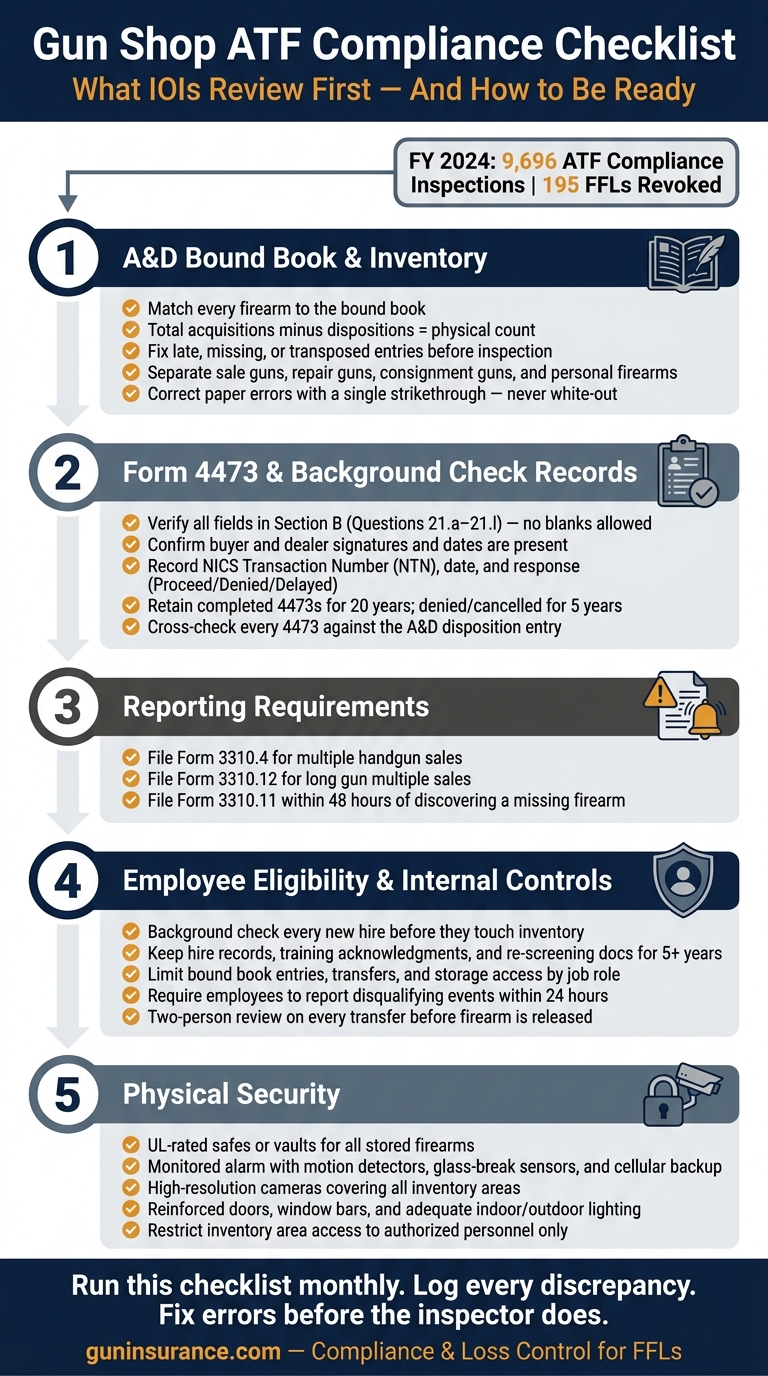
Here’s the short version of what matters most:
What I like about this checklist is that it stays focused on the items an IOI will usually review first: inventory, transfer records, reporting, staff controls, and on-site security. It also ties those same steps to business risk, since clean records and tighter controls can help cut theft, loss, and insurance problems too.
If you want the plain answer, it’s this: the shops in the best shape are the ones that check records often, fix errors the right way, and keep proof of what they reviewed.

IOIs start with an opening conference. At that stage, they confirm ownership, business structure, and who the "responsible persons" are on the license [5][1].
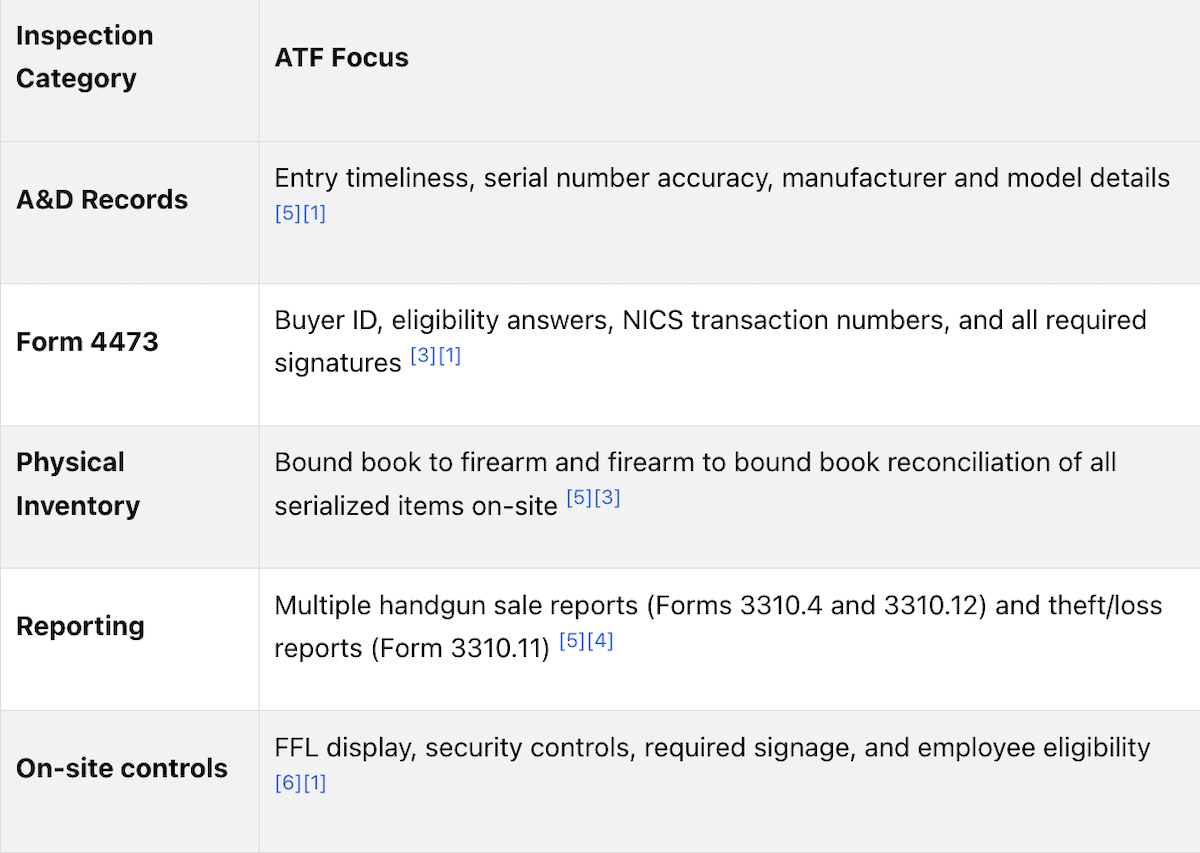
After that, the inspection usually moves into three main areas: the A&D bound book, Form 4473s, and physical inventory [5][3].
Use the table below to spot the same issues an IOI is likely to flag first.
Form 4473 review is often the most time-consuming part of the audit. IOIs look closely for missing signatures, wrong dates, and incomplete NICS documentation [5][3].
Run this checklist before an inspection. Write down each discrepancy, correct it, and then make sure the same problem isn't showing up again.
Then match the A&D bound book to every firearm on the premises.
Start with inventory first. This is where small record issues can turn into a problem fast during a routine inspection.
Pull the entries from your bound book and physically locate each firearm that should be in licensed inventory. Do a full hands-on count and make sure every serialized firearm matches the book. If a disposition entry no longer lines up with what’s on hand, fix it before the inspection starts.
The formula is simple: total acquisitions minus total dispositions should equal your current physical count. If those numbers don’t match, track down the reason before an inspector does. Do this check once a month. [4]
Once the count matches, review each acquisition and disposition entry to make sure it was recorded on time.
Go through each acquisition and confirm it was logged on time and matches the shipping or delivery records. A firearm can be physically present and still create a recordkeeping issue if the timing is off.
If a gun is missing and you cannot account for it, file Form 3310.11 within 48 hours of discovery. [9]
For paper records, fix mistakes with a single strikethrough. Never use white-out. If you use an electronic system, the software must keep the original entry, the correction, who made the change, and when it was made. [8]
After the count is settled, clean up the inventory categories.
Keep sales inventory, gunsmithing items, customer guns, and personal firearms separate and clearly marked. Any firearm kept overnight on the premises must be logged, including repair items, FFL transfers, and consignment guns. [10]
Tag personal firearms and store them away from licensed inventory. As Miles Hall, Senior Advisor at Hall-N-Hall Consulting, advises:
"Make sure all personal guns are tagged as such... Have a way to clearly identify those guns so when ATF does an inspection, they know why they are not in the A&D record." [4]
One point that trips up a lot of dealers is consignment and storage returns. If a firearm came in for consignment or storage, and not just for a simple repair, returning it to the owner requires a completed Form 4473 and a NICS background check. [4]
Use this table to spot the mistakes most likely to lead to an ATF finding.
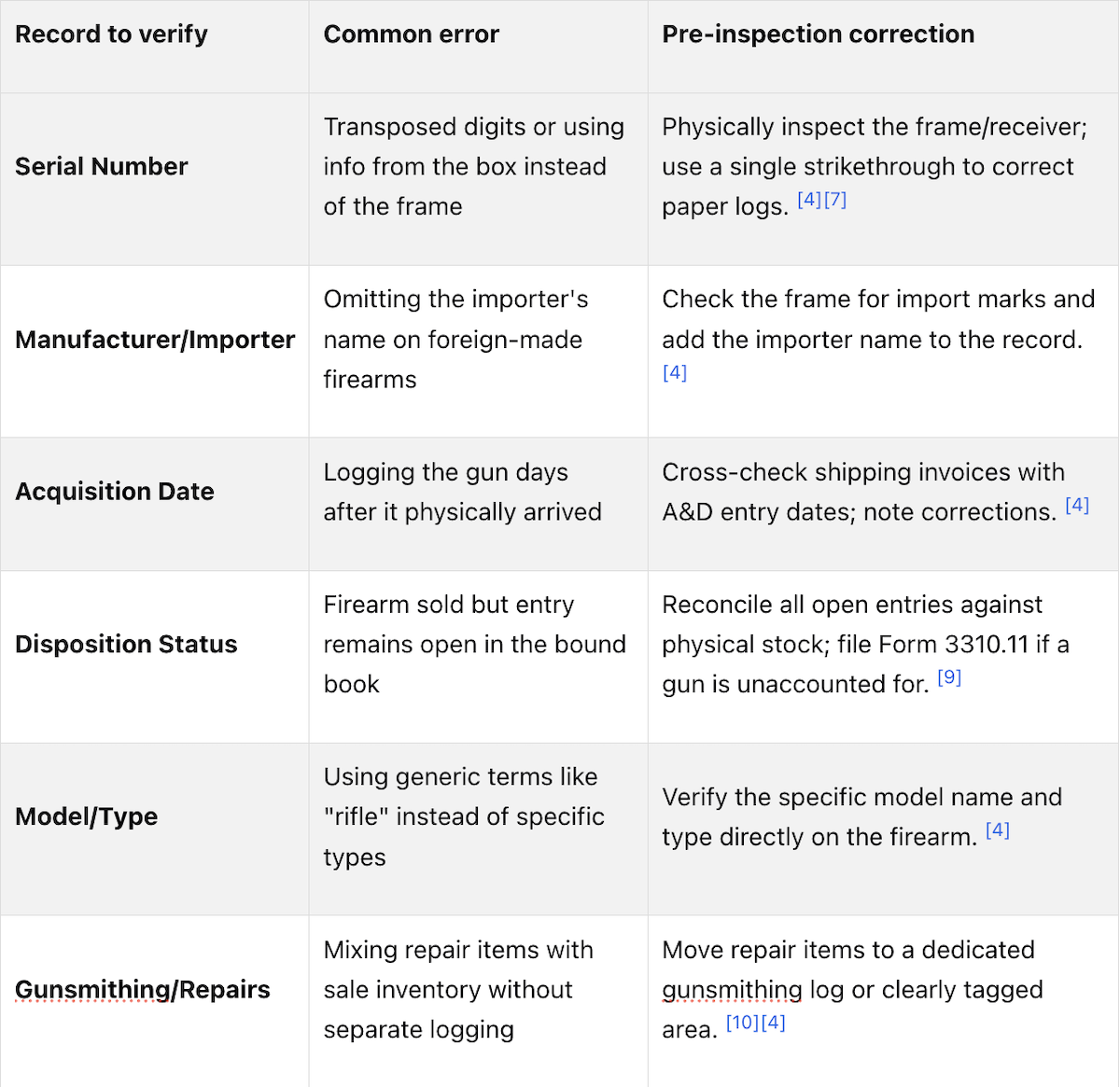
Correct errors before the inspection. If you fix them while the inspector is there, they can still be counted as findings. [7]
Form 4473 is the paper trail that shows your inventory review was done right. Each transfer file needs to line up with the firearm, the buyer, and the background check. Check every required field, signature, date, ID detail, and the current August 2023 Form 4473 revision. The buyer and dealer signatures and dates must all be there. Section B, questions 21.a through 21.l, can't have blanks. And the ID details need to match the person standing in front of you.
The errors that show up most often are simple but costly: blank answers, missing signatures or dates, hard-to-read entries, and firearm details that don't match the gun. If the buyer answers yes to any prohibited-person question, the transfer stops. A blank answer is also a problem. That's why it helps to have a second staff member review each completed 4473 before the customer leaves.
Completed Forms 4473 must be kept for 20 years. Denied or cancelled transactions must be kept for at least 5 years [3]. Write the NICS Transaction Number (NTN), the date the check was started, and the final response - Proceed, Denied, or Delayed - directly on the form [3].
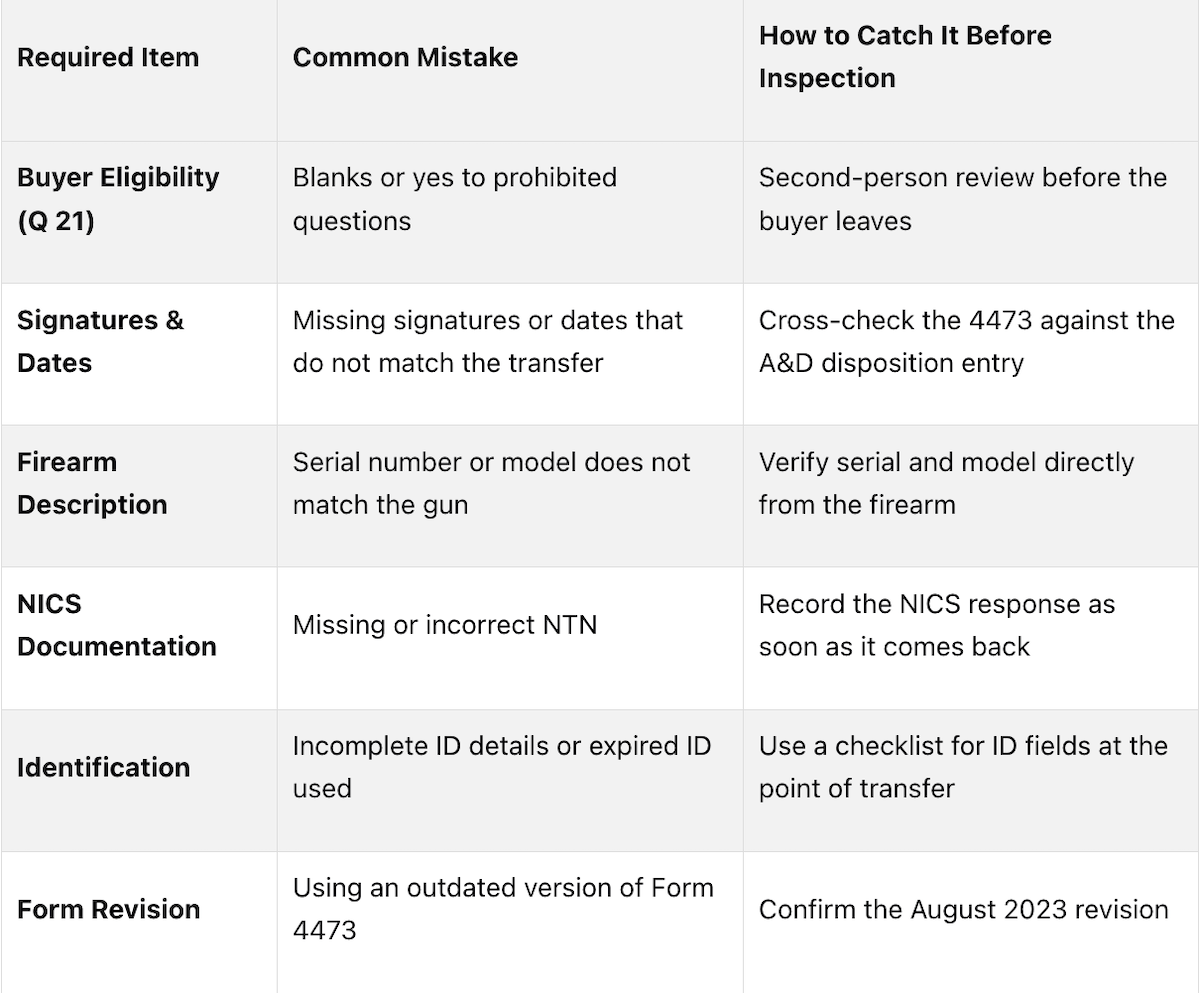
Delayed NICS responses need extra care. Count the three-business-day window the right way and write it down. Start counting after the check date, and skip weekends and holidays [5].
Then match each 4473 to the A&D disposition. Every Form 4473 should connect to a matching disposition entry in your A&D bound book, and that disposition entry should point back to the Form 4473 transaction number [3]. The transferee name, transfer date, firearm serial number, manufacturer, and model should match in both records [3].
One solid monthly habit is to pull 10 Forms 4473 at random and trace each one back to the A&D entry [3]. Check that the disposition was recorded within seven days of the transfer date and that the two records don't conflict. If you need to make paper corrections on Form 4473, photocopy the original, make the correction on the copy, initial and date it, and attach the copy to the original. Fix mismatches before the inspector finds them.
Next, verify who is allowed to handle transfers and recordkeeping.
Once your records match up, the next step is simple: make sure every person who touches those records is allowed to do so and knows the process.
Anyone in your shop who handles a firearm, completes a transfer, or makes an entry in the A&D bound book should have a clear file behind them. That file should include a hire record, a signed training acknowledgment, and a re-screening record. Federal law under 18 U.S.C. § 922(g) lists disqualifying conditions such as felony convictions, domestic-violence misdemeanors, restraining orders, and unlawful controlled-substance use [11]. If a person in one of those categories is handling guns or records in your shop, you have a compliance issue no matter what their title says.
Run a background check on every new hire before they touch inventory. Keep the results, signed consent forms, and any periodic re-screening records for at least five years [11]. When it's time to dispose of old employee records, use secure methods like shredding paper files or permanently deleting digital files [11].
Not every compliance issue starts with someone physically handling a gun. Sometimes the risk comes from access.
An employee who can reach inventory, codes, or records can still create a problem. So spell out who is allowed to:
If someone's role changes, update the authorization list right away. Then collect any keys, codes, badges, or hardware linked to the old role. Put those role limits in your SOP, and update them each time duties shift.
Check those permissions again during the monthly review.
This monthly review is where small gaps show up before an inspection turns them into a larger mess.
Review employee files each month so missing authorizations or expired training don't sit unnoticed. Confirm that every active employee has a current training acknowledgment on file. Also confirm that your internal log shows training activity, access changes, and any unusual activity [10].
Require employees to report any new disqualifying event in writing within 24 hours [11] [10]. If that happens, remove their access to firearms and records at once. If no other role is available, terminate employment [11].
It also helps to build in a second set of eyes. Require two employees to review every transfer before the firearm is released, and have a third person review completed Form 4473s before filing [10].
Keep hire files, training acknowledgments, authorization lists, re-screening records, and status-change logs current. An IOI will expect to see them. Retain background check results and consent forms for a minimum of five years, and keep training acknowledgments and self-reporting agreements for the full length of employment [11] [10].
These controls should be written down before physical security checks begin.
Once your records and staff controls are set, walk the building the way an IOI will.
IOIs don’t just review paperwork. They walk the floor. You should too, before they ever show up.
Start with locked storage. Firearms should stay in locked units when they’re not being actively handled. UL-rated safes or vaults, reinforced doors, window bars, and solid indoor and outdoor lighting are the starting point. Then review your surveillance system. High-resolution cameras should cover inventory areas, and your monitored alarm should include motion detectors, glass-break sensors, and cellular backup.
Use the same access rules you’ve already set for staff roles. Inventory areas should be limited to authorized personnel only, whether access is controlled by keys, codes, keycards, or biometric systems.
Keep retail, repair, and personal firearms in separate, clearly marked areas. Personal firearms should be separated and labeled.
Before inspection day, reconcile stored firearms to the A&D book.
Keep a running discrepancy correction log for record mismatches, inventory variances, and fixes made before any official inspection. This log should show what you found, how you traced it, and what you did to correct it. That gives you proof that the business is reviewing itself instead of waiting for an inspector to spot the problem.
Each entry should include:
Management should review this log on a regular basis, not only right before an inspection.
The point of the log is simple: use it to drive the fix, not just to note that something went wrong.
When you find a mismatch, handle it in a clear sequence: identify the issue, trace the source, make the permitted correction, and document the change.
For paper records, never use white-out. Draw a single line through the incorrect entry, write the correction, and have the employee initial and date the change, per ATF Ruling 2016-1 [2]. For digital systems, follow the audit-trail process so the change stays traceable.
"If you find something wrong or in error, get it fixed... Do whatever you have to do to minimize the long-term damage." - Miles Hall, Senior Advisor, Hall-N-Hall Consulting [4]
If the IOI finds problems, the cost starts right away.
You can expect a written report of findings and follow-up questions. Staff time will go into pulling records, explaining variances, and fixing issues. That means less time spent running the business and more time dealing with cleanup.
The same controls that cut down ATF findings can also cut down theft and liability losses.
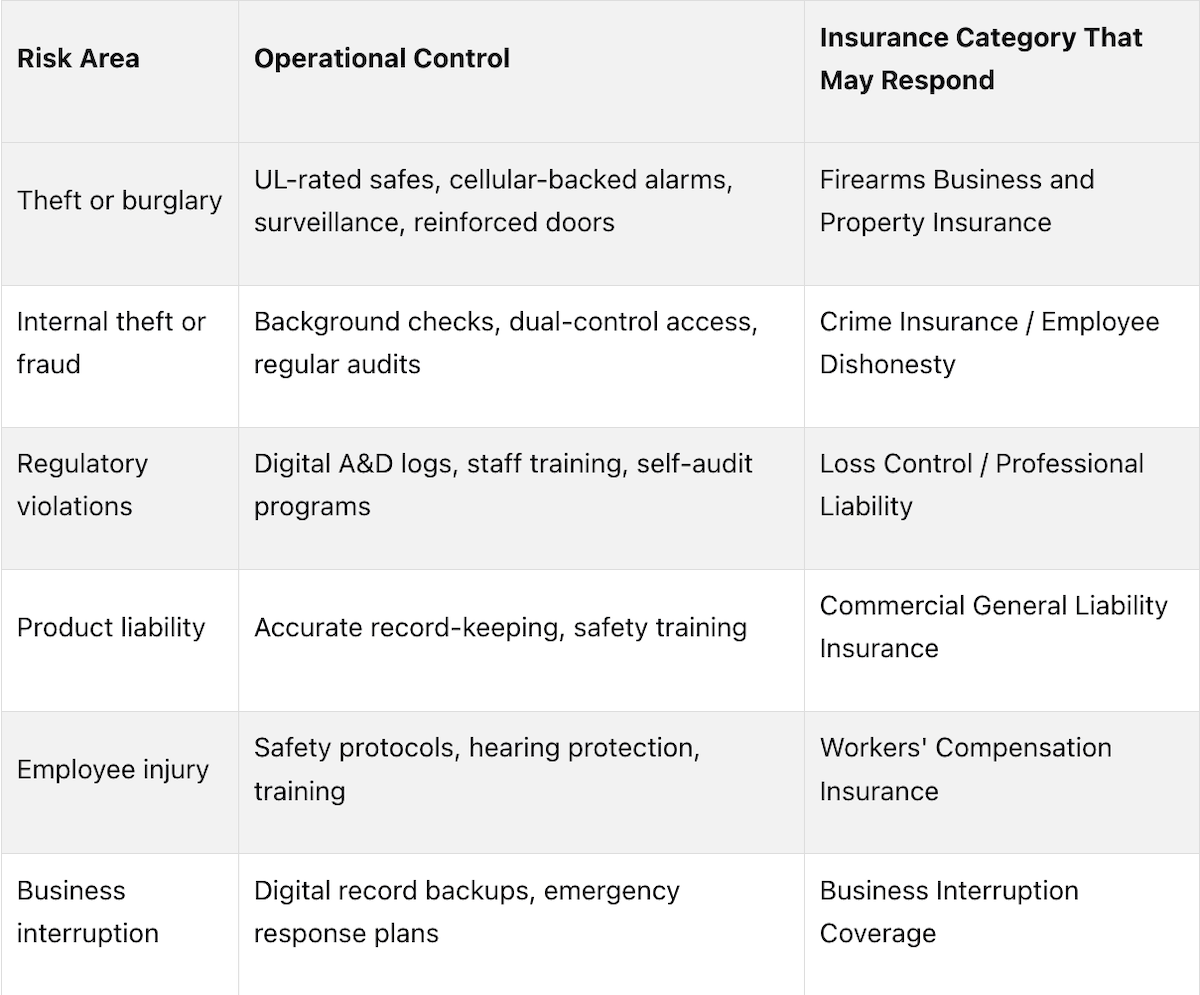
Compliance readiness and insurance readiness are the same discipline showing up in two systems. Joseph Chiarello & Co., Inc. (guninsurance.com) offers a loss control program built to spot these gaps before they turn into findings.
A gun shop that passes an ATF inspection usually does the same things that make it harder to disrupt, easier to run, and better protected day to day.
Verify your A&D bound book against every firearm on the premises. Clean up Form 4473 files and cross-check them against disposition records. Confirm that employee authorization lists are current. Walk your physical security the way an inspector would. Keep a discrepancy correction log running so you can show what you found and what you fixed.
Every item on this gun shop compliance checklist cuts your exposure to inspection findings, theft, liability, and the operational disruption that can hit when someone else finds the problem first. Tight records and tight controls don’t just satisfy an IOI. They protect the business you’ve built.
Conduct a full physical inventory audit at least once a year to reconcile your bound book with the firearms you have on hand. If you want steadier compliance and to stay ready for an inspection, monthly or quarterly audits are a smart habit.
During each audit, do both book-to-gun and gun-to-book checks. That means confirming every serialized firearm in your records is physically present, and every firearm on hand appears correctly in the bound book.
Keep clear records for each employee. That includes a government-issued photo ID, Social Security card, employment history, criminal history reports, and any job-related certifications.
For new Responsible Persons, keep copies of submitted ATF Form 7/7CR Part B, FD-258 fingerprint cards, photographs, training records, disciplinary notes, and meeting minutes. Those records help show ongoing oversight and compliance.
If you discover that a firearm is missing, report the theft or loss to the ATF and local law enforcement within 48 hours of finding out. Make the report by phone and in writing with ATF Form 3310.11.
If a self-audit turns up record errors or other mismatches, look into them right away. Then match your physical inventory against your A&D logs. Joseph Chiarello & Co., Inc. helps FFL holders spot these compliance weak points before they turn into violations.
Don't wait until it's too late to make sure your gun shop is covered. At Joseph Chiarello & Co., Inc., we’re here to help you navigate the ins and outs of gun shop workers compensation insurance to ensure you're prepared for any noise-related risks, including hearing damage. Reach out to us today to review your current policy or get a customized quote. Protect your team and your business with the right coverage—because their safety is worth it.
Call Now: 800-526-2199. Or submit your inquiry below. We look forward to having the opportunity to work with you!