

If your policy does not cover negligent instruction, off-site classes, and live-fire claims, you may be paying for insurance that fails when you need it most.
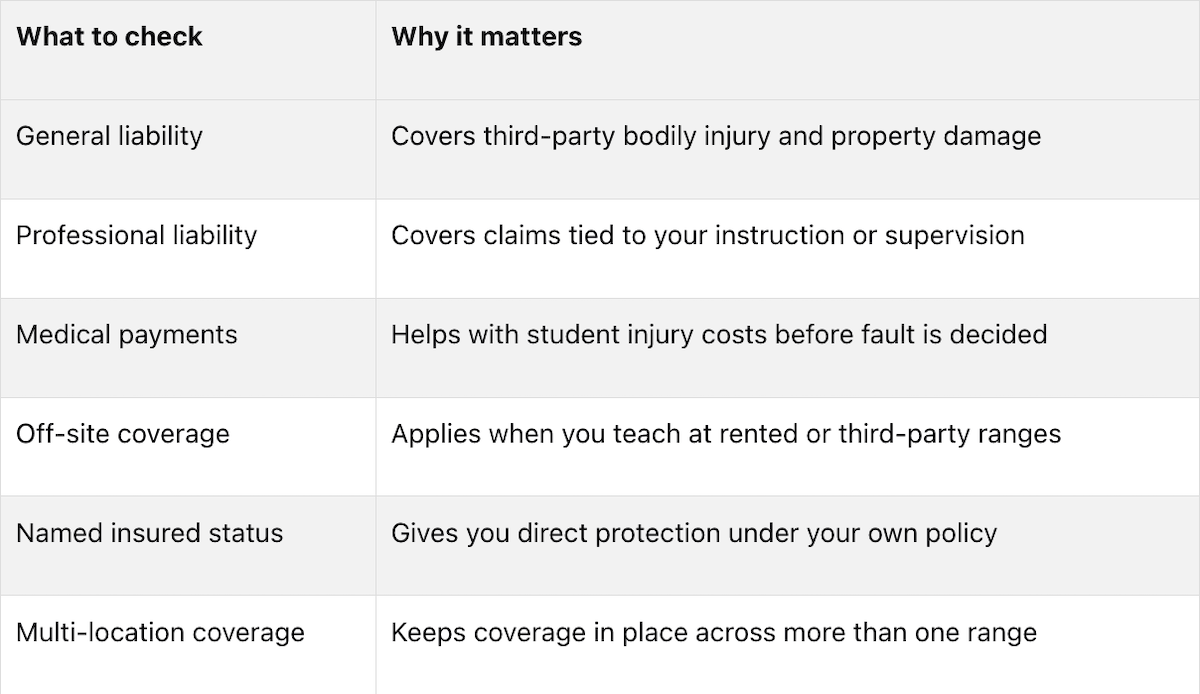
I’d boil this down to five checks:
One point stands out: a standard general liability policy often covers bodily injury and property damage, but it may not cover claims tied to how you taught. That gap matters. In one February 2024 New York case, a trainee was shot during a safety demo after an instructor failed to confirm a gun was unloaded and mixed live rounds with dummy rounds. The court found the instructor negligent and awarded damages.[1]
Legal costs can add up fast too. Firearms-related liability defense can run $100 to $500 per hour.[2] So even if a claim does not end in a large payout, the cost to respond can still hit hard.
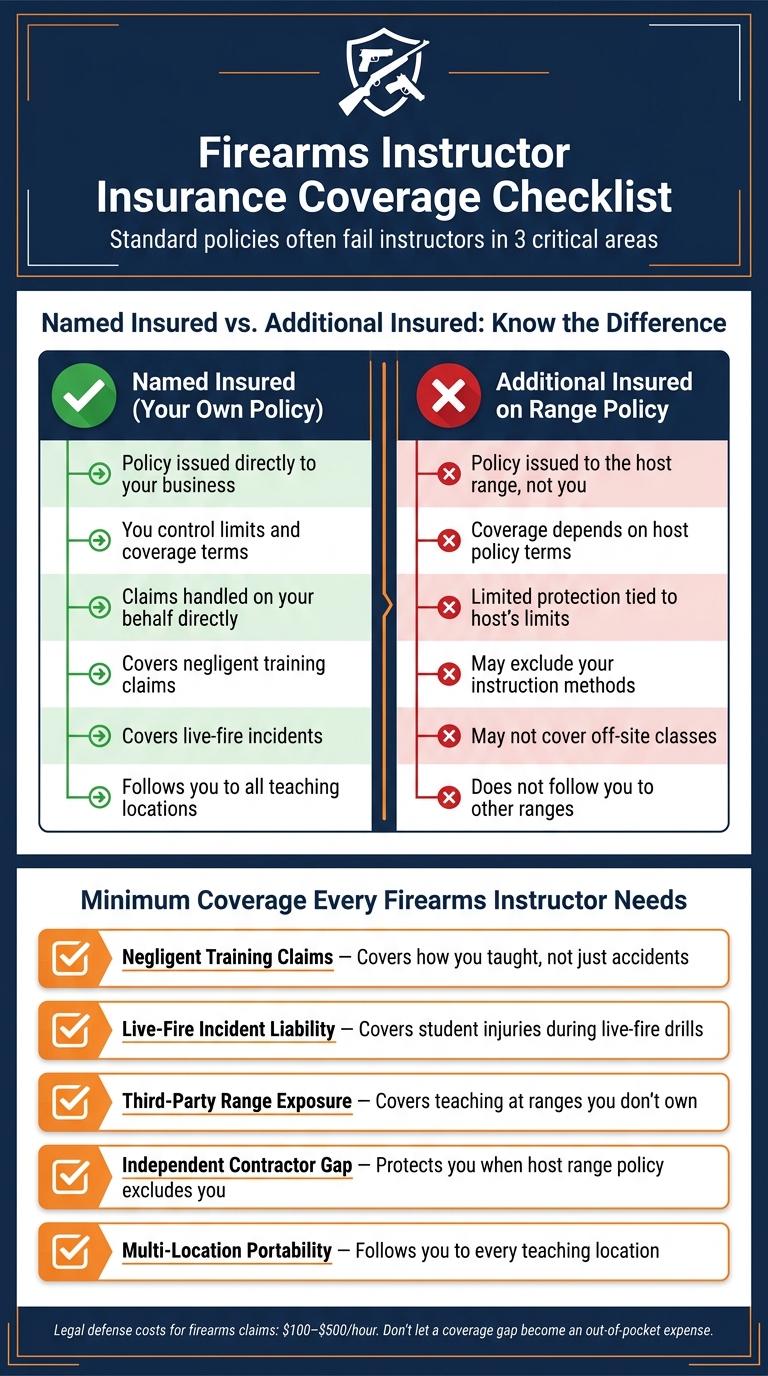
Here’s the short version: your policy should follow you, not just the range. Being listed on a range’s policy is not the same as being the named insured on your own policy.
Before you teach your next class, I’d check your declarations page, endorsements, and range agreement to see what is actually covered.
You don't find out what a policy means when you buy it. You find out after a claim, when exclusions and limits decide who pays.
Standard general liability usually covers accidents. It often does not cover the professional judgment behind your instruction.
The gaps tend to show up in three places: training claims, range-site claims, and contractor-status issues.
When a student gets hurt and the claim focuses on your instruction, a standard GL policy may exclude the instruction itself.
A negligent training claim might say you failed to screen a student's experience level before a live-fire drill, that your range commands were unclear, or that you didn't step in when a student showed unsafe muzzle discipline. That's not a simple slip-and-fall claim. It's a claim about how you taught.
If your policy doesn't include a professional liability part written for firearms instruction, you may end up paying for your own legal defense out of pocket - even if you did nothing wrong.
And if one student injures another, the instructor often gets named in the claim too. Whether your policy responds comes down to the wording.
Teaching at a range you don't own or lease creates third-party range exposure.
In plain English: the range's coverage usually protects the facility, not your instruction. So if a student says your teaching caused the injury, the facility's insurer may deny the claim. At that point, you're left to handle it yourself.
This gets trickier when you teach at more than one location. A policy that doesn't clearly follow you to off-site classes can leave some trainings uncovered. That's why the policy needs to follow the instructor, not just the facility.
Coverage can also shift based on how you work. If you teach as an employee, you may be covered under the employer's program. If you teach as an independent instructor, that protection often doesn't come with the job.
Independent contractors usually don't get automatic protection under a range's policy. In most cases, independent instruction calls for your own policy that follows your work.
That's why the wording matters more than the certificate. The next step is checking whether your policy actually includes those protections.
Those gaps only matter if the policy wording fills them. When you review a firearms instructor liability insurance policy, check for medical payments, property damage, and off-site location coverage - not just bodily injury and claims defense.
A solid policy starts with general liability. That covers third-party bodily injury and property damage tied to your instruction, whether you're teaching in a classroom or out on a range.
Then there's professional liability. That covers claims saying your instruction, supervision, or commands were negligent.
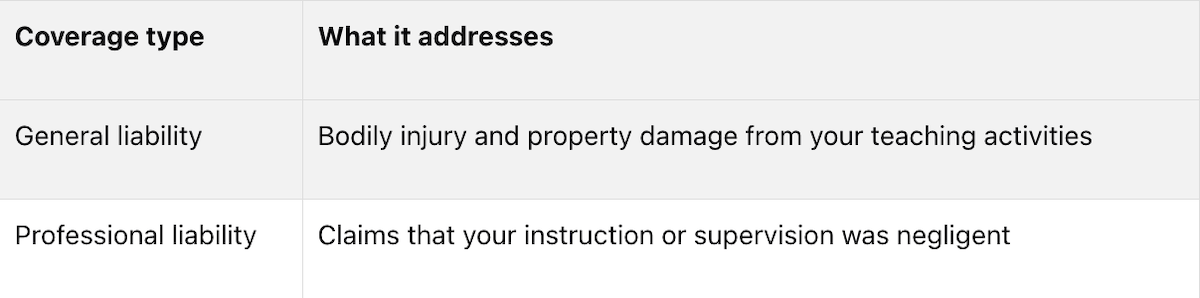
Those two coverages matter, but by themselves they can still miss some common instructor losses.
Medical payments coverage helps with student injuries during instruction without needing a liability finding first. That's useful if a student gets hurt during a live-fire drill and needs care right away.
Property damage coverage applies when equipment or range property gets damaged during class.
And multi-location coverage makes sure your policy applies whether you're teaching at your home range, a rented facility, or a third-party range across town.
A policy should follow the instructor, not just the facility.
Without both general and professional liability, a training claim can end up outside coverage. The added exposures above are what make a policy line up with the work instructors do during classroom sessions, live-fire drills, and travel between ranges.
Once you've spotted the exposure, the next step is simple: check whether the policy is written for your instruction business or whether you're only tied to the range.
Start here: is the policy in your name, or is it only attached to the range?
Being listed as an additional insured on the range's policy is not the same as having your own coverage.
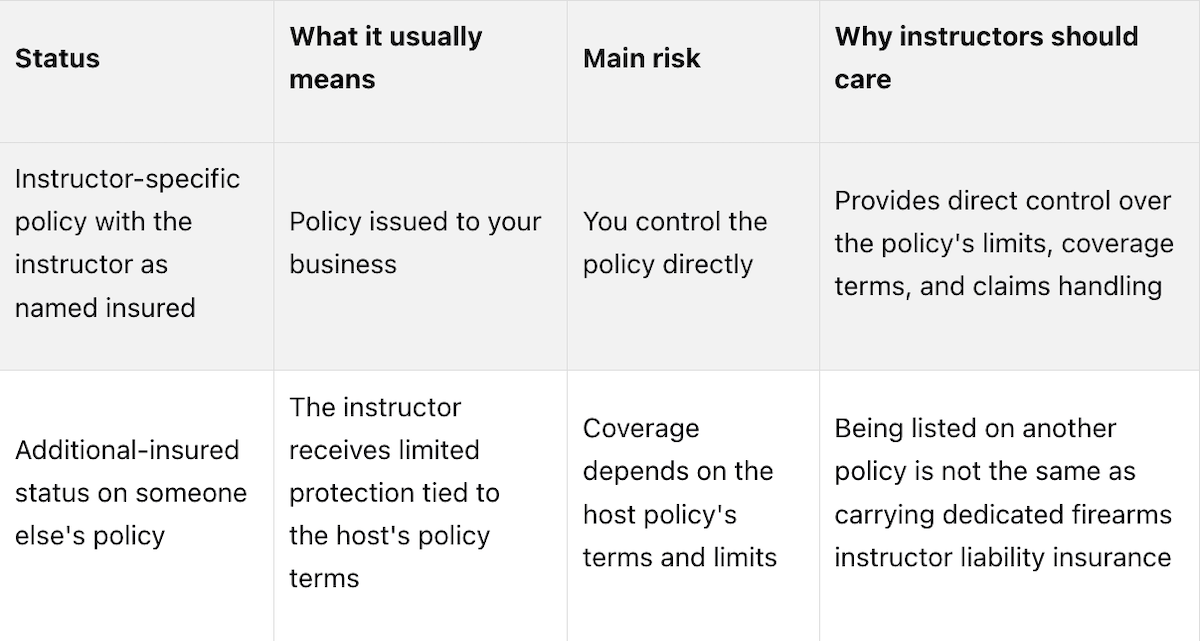
If the policy is not in your name, read the endorsements before you assume you're covered.
To check your status, pull the declarations page and look for your name under Named Insured. Then review the additional insured endorsement, the certificate of insurance, and the range agreement. Those documents show whether you're the named insured and which endorsements apply.
A certificate of insurance shows that coverage exists. What it does not show is the full set of policy terms.
For that, you need the declarations page and any additional insured endorsement. Those are the documents that show who is insured and what protection is actually in place.
If the policy is tied to a host range or club, make sure it stays active and that it covers your instruction.
Once you know what your policy covers, the next step is simple: tighten up the records and safety steps that can back you up if a claim shows up.
Your class records do two jobs. They help defend a claim, and they show underwriters that you run a disciplined operation.
The core records every instructor should keep include lesson plans, safety briefings, waivers, attendance logs, equipment checks, incident reports, and emergency procedures. Together, they create a paper trail that can help defend against negligent training claims and live-fire incidents.
When that documentation stays consistent across solo lessons and multi-student classes, underwriters get a clearer view of your risk. Over time, a clean record can help support better pricing.
If your policy still reads like generic business coverage, it may be time to have a firearms insurance specialist review it.
Standard commercial underwriters often miss the risks tied to firearms instruction. Joseph Chiarello & Co., Inc. has spent 40+ years serving firearms instructors, NRA-certified trainers, and pistol instructors. That kind of focus matters. Instructor-specific underwriting lines up better with live-fire instruction, multi-location teaching, and professional liability - the core exposures for instructors who teach at multiple ranges or work as independent contractors.
Here’s the final check.
A workable policy for firearms instructors should address at least five things:
If your current policy says nothing about any one of those, you likely have a gap worth fixing before your next class date.
Waivers can help, but they do not erase liability. And being listed on a range’s policy is not the same as having your own dedicated coverage.
Before your next class, verify that live-fire instruction is covered and that your policy follows you to every teaching location.
In most cases, you need both.
Here’s the simple reason: general liability and professional liability deal with different kinds of risk.
General liability covers physical accidents. That can include a student tripping, someone getting hurt on-site, or accidental damage to someone else’s property.
Professional liability covers claims tied to your training, advice, or judgment. If someone says your instruction led to an injury, this is the coverage that can help with legal defense and possible settlement costs.
Yes, your coverage can follow you to different ranges if your policy is set up for mobile operations. The big thing is to confirm that your policy covers all locations where you teach.
If you work at more than one site, check your policy terms, keep records like attendance logs and liability waivers, and make sure your instruction stays within your certified training scope. Joseph Chiarello & Co., Inc. specializes in coverage for firearms instructors.
No. A waiver does not protect you from a claim.
It can help with your business’s risk management, but it does not erase liability or prevent someone from suing you.
If an incident happens, you may still deal with legal fees, settlements, or court judgments. Joseph Chiarello & Co., Inc. points out that professional and general liability insurance can help protect your business and assets when legal issues come up.
Don't wait until it's too late to make sure your gun shop is covered. At Joseph Chiarello & Co., Inc., we’re here to help you navigate the ins and outs of gun shop workers compensation insurance to ensure you're prepared for any noise-related risks, including hearing damage. Reach out to us today to review your current policy or get a customized quote. Protect your team and your business with the right coverage—because their safety is worth it.
Call Now: 800-526-2199. Or submit your inquiry below. We look forward to having the opportunity to work with you!