

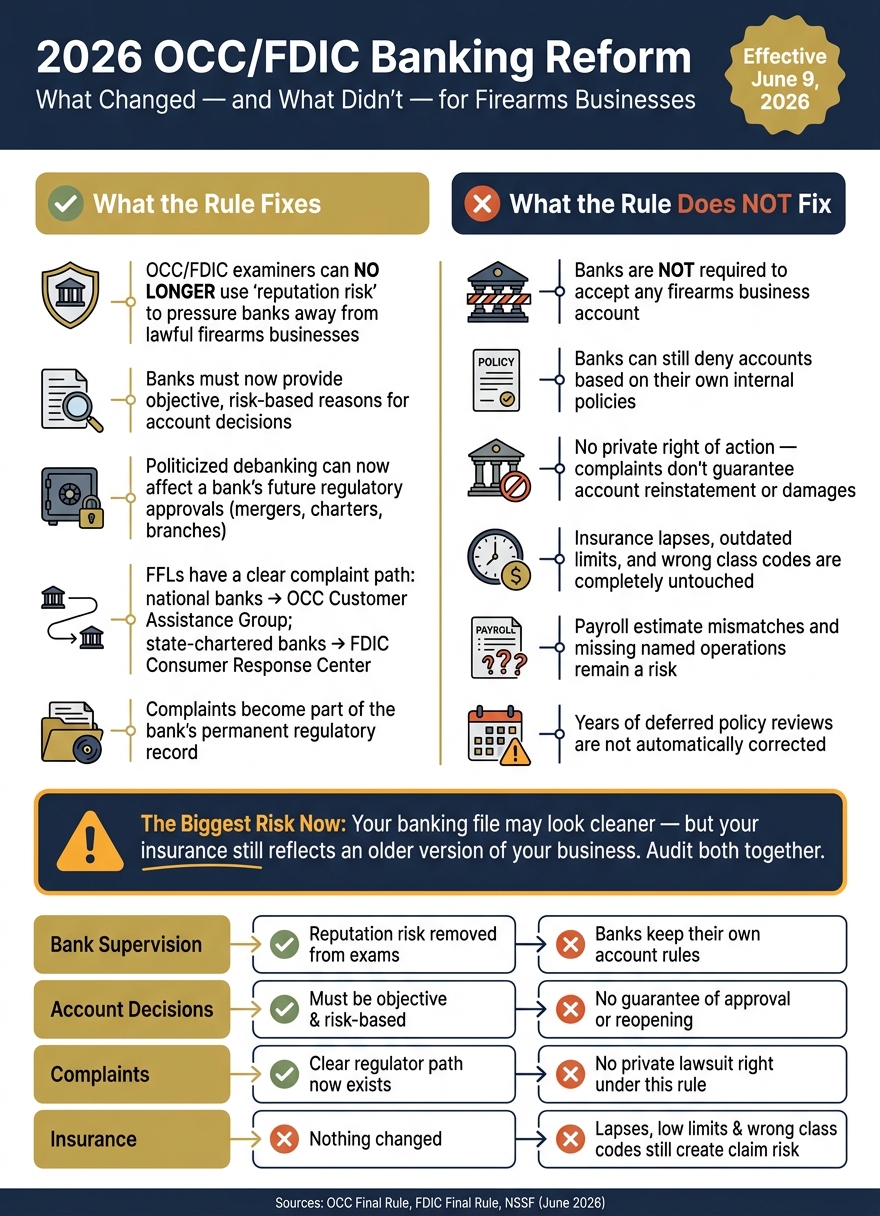
Bottom line: the June 9, 2026 rule helps with bank pressure, but it does not fix your insurance.
If I run an FFL, range, training business, or firearms shop, here’s what I need to know right away:
That’s the main shift. The banking rule removes one source of pressure, but it does 0% to restore lost coverage or fix policy errors from past disruption.
A simple way to look at it:
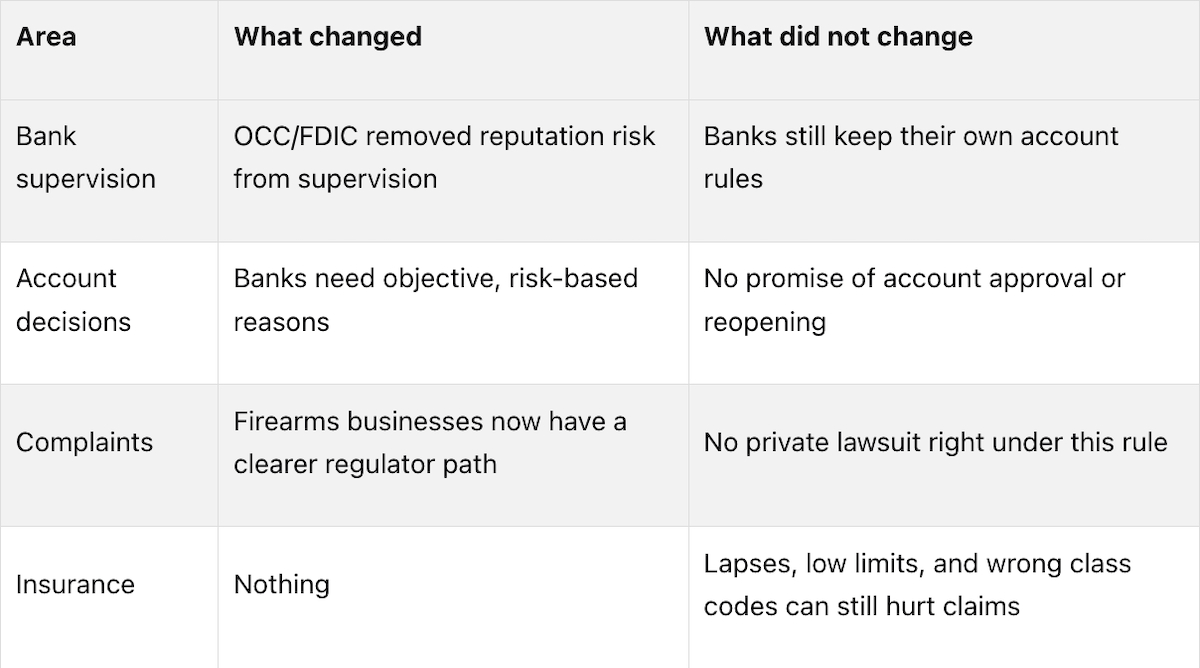
So if I were reviewing this rule in plain English, my next move would be simple: check bank records and insurance policies side by side, now - not after a claim, audit, or account shutdown.
Regulators started using "reputation risk" in the late 1990s. In plain English, it gave examiners room to question a bank’s ties to certain customers based on how those ties might look to regulators or the public, not just on measurable financial or operating risk.
The OCC’s own bulletin says it is the risk that an activity "could hurt public perception without any financial or operational problem." [1] That’s a big deal. It meant the standard could be applied on perception alone.
For firearms businesses, that often put accounts in a tough spot. The risk wasn’t always about payment history, controls, or business performance. Sometimes it was about optics. That history is why this rule matters: it takes away a tool banks used during supervision to support de-risking firearms accounts.
Federal examiners at the OCC and FDIC can no longer criticize or take adverse action against an institution on the basis of reputation risk. [9] More than that, the rule stops regulators from requiring, instructing, or encouraging a bank to close accounts or deny services because customers are involved in lawful but politically disfavored businesses. [9]
That change has teeth. Banks can face regulatory consequences for politicized debanking in future approvals. [2][4]
At the same time, this does not mean every private bank has to serve every lawful business. Banks still control their own account policies. So the rule addresses regulatory pressure, not automatic access.
For FFLs, ranges, instructors, and manufacturers, the day-to-day shift is pretty clear: banks now need objective, risk-based reasons for account decisions. [3][11] They can still ask for strong records. They can still review controls. But they can’t lean on reputation alone.
That means the basics still matter:
Those items still sit at the center of gun dealer banking compliance. [4][2][10]
"Banking decisions must be based on individualized, objective, risk-based analysis rather than politics or ideology." - Larry Keane, Senior Vice President and General Counsel, NSSF [2]
So the change here is real, but it’s not a free pass. Gun dealer banking compliance has shifted, not eased. Banks now have to document objective reasons for account decisions, but the rule does not force them to reopen accounts. It also does not repair insurance gaps that may have opened up along the way. And when banking stress hangs around, insurance files often fall behind.
The new rule stops OCC and FDIC examiners from leaning on banks to act based on reputation risk alone. It also stops regulators from requiring, instructing, or encouraging banks to close lawful firearms-related accounts for that reason. [1][12]
That’s a meaningful shift. Banks that still take part in politicized debanking can now face fallout when they seek future regulatory approvals. [2][4] In plain English: the pressure on banks has changed. But business owners still need to keep their own records clean and their files in order.
This rule does not force every bank to accept firearms businesses.
A bank can still say no if its own internal policy blocks firearms accounts. Some banks still list firearms sales as prohibited under internal policy. [3][12] So yes, a bank may still restrict a firearms merchant. The key difference is that it cannot do so because a regulator nudged it behind the scenes.
Banks still need objective risk-based reasons. They can’t take reputation concerns, slap a compliance label on them, and call it a day. [4]
If your account is limited or closed after June 9, 2026, start by asking for the written reason. Then file a complaint with the OCC or FDIC, based on the bank’s charter. [2][3]
Here’s the basic path:
Those complaints don’t just disappear into a void. They become part of the bank’s regulatory record and are reviewed when the bank seeks approval for things like mergers, charter changes, or branch openings. [2][4] The OCC has said it may deny or place conditions on those approvals when there’s a documented record of politicized debanking. [2]
There’s one limit that matters a lot: the rule does not create a private right of action. [3] That means filing a complaint does not promise account reinstatement or money damages. What it does do is build a record with regulators, and that record may matter later. It may help with banking access down the line, but it does not fix insurance or coverage gaps caused by years of disruption.
The rule changes bank supervision. It does not fix insurance policies that drifted out of date during years of account disruption. For many firearms businesses, renewals and policy reviews got pushed aside while banking was unstable. That created a second problem: coverage that no longer fits the business.
When an account closes without warning, replacing banking takes over. Insurance work often gets pushed to the side. That delay left many policies out of date. [3]
The most common problems are lapsed policies, outdated limits, and wrong class codes. [6]
A lapsed policy is usually the most urgent issue. If premium payments were tied to a merchant account or payment platform that got disrupted, coverage can lapse without the owner noticing right away. [5][13]
Outdated limits tend to show up later, but they can hit just as hard. A business may now carry much more inventory or property value than the policy shows. If the limit never changed, the owner has to cover that gap out of pocket after a fire or theft. [6]
Wrong class codes are often the hardest to spot. Maybe a shop added gunsmithing, training, range operations, or other named operations during those disruption years. If the policy still lists only a basic retail business, some of that work may sit outside the policy. [6]
That’s the rough part: these gaps usually stay hidden until a claim or audit brings them into the open.
The rule may limit supervisory pressure, but it does not update policy records, inventory values, payroll estimates, or class codes. [3][6][7][11]
Businesses that dealt with repeated bank changes often put off routine insurance upkeep. One delay led to another. Even if banking is more stable now, that does not set off a policy audit on its own. Someone has to review it on purpose. [3][11]
The next issue is where these gaps tend to surface first.
Burglary, theft, vandalism, extreme weather, and products or instruction claims are often the first places underinsurance shows up. [6]
Fire losses expose limit problems fast. If property values or inventory levels were never updated, the payout will fall short of the actual loss. [6]
Workers' compensation audits are another pressure point. Frozen payroll runs and staffing changes can leave payroll estimates out of line with reality. That can lead to an unwelcome audit adjustment. Joseph Chiarello & Co., Inc., with more than 40 years of uninterrupted industry presence, regularly helps firearms businesses keep that part of coverage aligned with current operations. [3]
The fix is a side-by-side audit of banking and coverage.
Now that the rule is in place, the job shifts from waiting to documenting. Pull together every banking relationship your business has: deposit accounts, merchant services, and credit lines. For each one, record the bank and note whether it is a national bank regulated by the OCC or a state-chartered insured bank regulated by the FDIC. That split matters because it tells you where to file a complaint if trouble shows up later. [3]
Then contact each bank in writing and ask whether its internal policies have been updated to match the June 9, 2026 OCC/FDIC final rule. Save every reply. You should also keep records that show the kind of objective risk support banks are supposed to rely on, such as creditworthiness, anti-money laundering controls, customer verification, and fraud prevention. [3][4]
If a bank limits or closes an account without a clear objective reason, file a formal complaint through the OCC or FDIC portal. That complaint becomes part of the bank's regulatory record. [3][4] And don't put all your eggs in one basket: keep a backup banking relationship in place so one bank decision doesn't turn into a full business shutdown.
Once that banking file is in order, turn to insurance before a claim or renewal puts a hole in your coverage.
Start with the basics. Make sure every policy, especially Commercial General Liability and Commercial Property, is active right now and that premiums have cleared with no interruption. A banking issue or closed merchant account can lead to a missed payment and a lapse that slips by unnoticed. [6]
Because years of banking trouble pushed many policy reviews to the back burner, this should be treated as a catch-up audit, not just another renewal check. Review named insureds and locations. Update property and inventory limits. Check that class codes and covered operations line up with what the business is doing today. [6]
Joseph Chiarello & Co., Inc. (guninsurance.com) has provided purpose-built coverage for FFL holders for more than 40 years - continuously through the entire debanking era - and can help line up policy descriptions with actual operations before a claim exposes a gap. [6]
The June 9, 2026 OCC/FDIC final rule removes reputation risk from supervision and gives FFLs a complaint path when account decisions lack objective support. [3][8] But it does not force any bank to take a firearms account, and it does not fix insurance coverage that slipped during years of banking instability. [8][11] Banking and insurance need to be fixed together. If one side is weak, it can wipe out the gains made on the other side.
File your complaint with the OCC or FDIC, based on which agency regulates the bank tied to your debanking case.
Be specific. Add dates, account details, notices from the bank, and any other documents that show what happened. Concrete facts help regulators spot patterns, especially when a bank appears to be making decisions for political reasons or without looking at each case on its own.
Your complaint may also become part of the formal record. That means it could be reviewed later in bank licensing filings or during Community Reinvestment Act examinations.
Under the new rule, banks can still close accounts for valid safety-and-soundness reasons. But those reasons need to be objective and documented. They can't rest on political or social views.
That can include issues tied to creditworthiness, fraud risk, operational risk, or specific BSA/AML compliance duties. In plain English: the bank has to look at your business and make a case-by-case decision, not rely on a blanket policy against an entire industry.
Start by reviewing your CGL and commercial property coverage.
Your CGL policy should cover legal defense costs and damages tied to non-professional negligent acts. That’s the baseline. If a claim lands on your desk, you want to know the policy is set up to respond the way you expect.
Your commercial property coverage should also match the way your business runs day to day. That means protection for common losses like fire, theft, and burglary, plus business-specific exposures such as valuable records and inland transit.
It’s also smart to review the details that often get skipped:
Joseph Chiarello & Co., Inc. has provided purpose-built coverage for FFL holders for over 40 years.
Don't wait until it's too late to make sure your gun shop is covered. At Joseph Chiarello & Co., Inc., we’re here to help you navigate the ins and outs of gun shop workers compensation insurance to ensure you're prepared for any noise-related risks, including hearing damage. Reach out to us today to review your current policy or get a customized quote. Protect your team and your business with the right coverage—because their safety is worth it.
Call Now: 800-526-2199. Or submit your inquiry below. We look forward to having the opportunity to work with you!