

Federal Firearms License (FFL) holders must meet strict ATF compliance standards to legally operate. This includes accurate recordkeeping, conducting required background checks, and following federal, state, and local laws. Key takeaways:
Failing to comply can lead to license revocation, fines, and legal consequences. On the other hand, staying compliant builds trust with regulators and customers while ensuring smooth ATF inspections.
Pro Tip: Organize records, train employees, and consider specialized insurance to mitigate risks tied to theft or compliance errors.
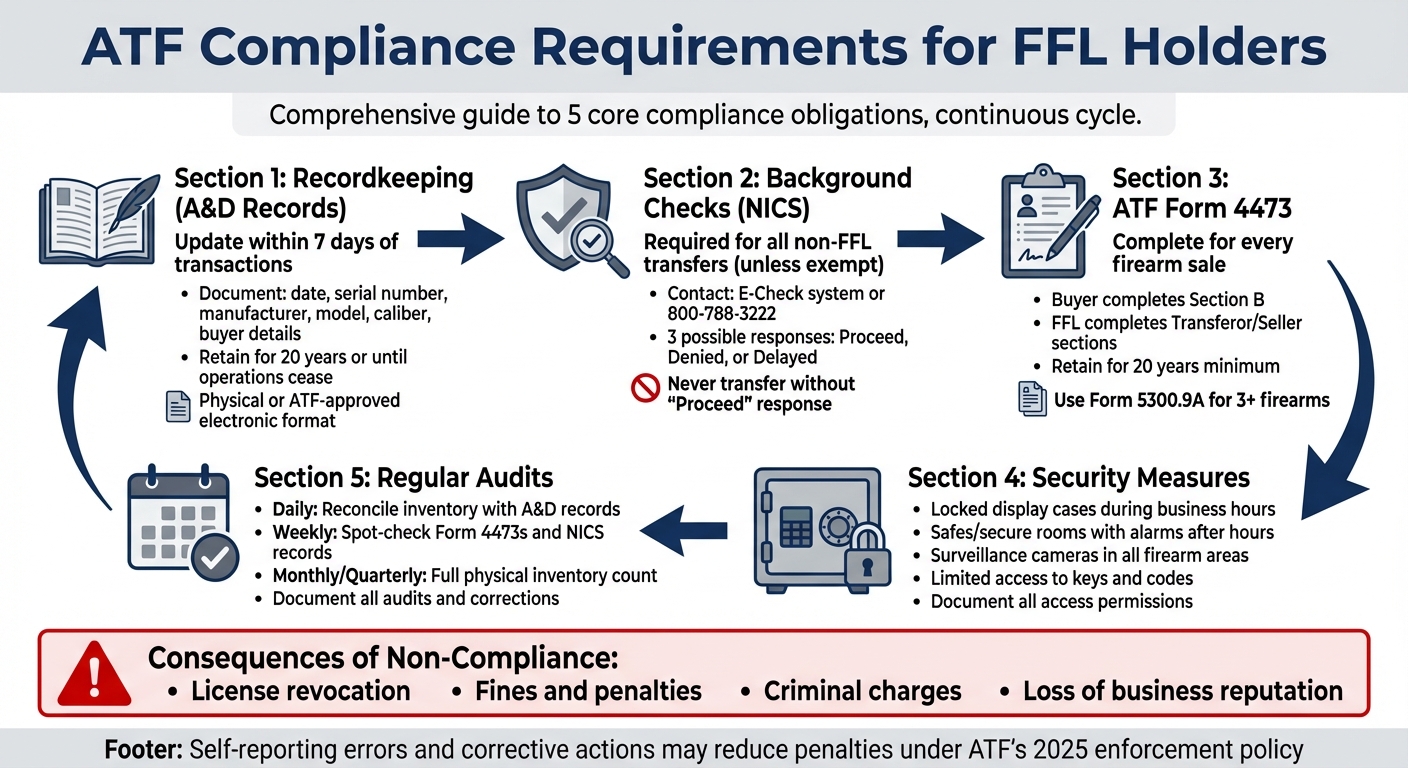
Your Acquisition and Disposition (A&D) records, often called the "bound book", are the cornerstone of ATF compliance. These records meticulously track every firearm entering or leaving your inventory, creating a detailed log for ATF inspections.
For each firearm, you’re required to document specific details: the transaction date, the firearm’s serial number, manufacturer/importer, model, caliber/gauge, and the buyer's name, address, FFL number, and license type. These entries must be recorded within seven days of any disposition [1].
Your bound book can be maintained as a physical ledger or an ATF-approved electronic record, but it must be permanent. Disposition records must be retained for 20 years or until you cease operations [1]. During inspections, ATF Industry Operations Investigators will match your firearms inventory against these records. Any inconsistency could signal diversion or trafficking risks, making precise recordkeeping essential for compliance and public safety.
Common violations include incomplete or delayed entries, which are often flagged during ATF inspections. Intentional omissions can lead to severe consequences: fines, license revocation, or even criminal charges. These errors also hinder law enforcement’s ability to trace firearms [4]. To avoid such issues, conduct regular self-audits to align your physical inventory with your bound book. Using electronic recordkeeping systems can also help minimize human errors.
Once your records are in order, the next step is ensuring thorough NICS background checks to maintain compliance.
For nearly every non-FFL firearm transfer, a NICS background check is mandatory [1]. The process is straightforward but must be executed carefully. First, have the buyer complete Section B of ATF Form 4473 and verify their identity with a valid government-issued photo ID. Then, contact NICS - via the E-Check system or by calling 800-788-3222 - and provide the information from Form 4473. NICS will issue one of three responses: Proceed (approve the transfer), Denied (block the transfer), or Delayed (indicating further review is needed). These results should be recorded on Form 4473 [1].
Some states act as Point of Contact (POC) states, requiring you to contact a state agency instead of the FBI. Additionally, certain transfers are exempt from NICS checks, such as those to other FFLs or individuals with valid state permits meeting federal standards under 18 U.S.C. 922(t)(3). Never transfer a firearm without receiving a "Proceed" response or meeting other lawful conditions. The firearm must be delivered only to the buyer listed on Form 4473 - not to a friend, family member, or representative. This rule is critical in preventing straw purchases [1].
Accurate NICS results ensure that Form 4473 is complete, providing a detailed record of every transaction.
ATF Form 4473 (Firearms Transaction Record) is the official document for recording over-the-counter firearm transfers to non-licensees. It includes buyer information, firearm details, and NICS check results, playing a crucial role in firearm tracing and criminal investigations [1].
This form must be completed for all qualifying transactions. For transfers involving more than three firearms, additional units should be documented using Form 5300.9A [1]. Buyers are responsible for filling out Section B, which includes their personal details and eligibility questions. As the FFL, you’ll complete the "Must Be Completed By Transferor/Seller" sections. These require you to verify the buyer’s identity, record firearm details (manufacturer, model, serial number, type, caliber), document NICS results (transaction number and response), and certify compliance by signing the form [1].
All transaction information must be recorded directly on Form 4473 or its continuation sheet - never on separate notes or documents.

Completed Forms 4473 should be stored in a well-organized, chronological filing system to ensure they’re accessible for ATF inspections. These forms must be retained for at least 20 years or until you cease operations [1]. Failing to complete Form 4473 when required, or submitting it with errors, are serious violations. Such mistakes can undermine law enforcement efforts to trace firearms used in crimes.
To reduce errors, regularly audit your Forms 4473 for issues like missing signatures, incomplete NICS details, or mismatched IDs. Training your staff on proper procedures and using a dual-entry verification system can help catch mistakes early. Under the ATF's updated enforcement policy, self-reporting errors and taking corrective actions may be considered mitigating factors during inspections [4].
Beyond keeping accurate records and documenting transactions, maintaining strong security and internal controls is essential for compliance. Since ATF inspectors assess these measures during every inspection, it's crucial to approach security as a daily practice, not just an annual task [3].
Start by implementing multiple layers of physical security. During business hours, use locked display cases. After hours, store firearms in safes or secure rooms with reinforced doors and monitored alarm systems. High-value firearms and NFA items should always be locked in a safe or vault when the business is closed. Install surveillance cameras to monitor all areas where firearms are handled or stored. Limit access to keys and security codes to trusted staff only, document who has access, and update codes whenever an employee leaves [3].
Incorporate compliance into your daily workflows to ensure critical tasks are never skipped. Log every firearm in your A&D record immediately upon receipt, including all required details. For each retail transfer, follow a consistent checklist: confirm the buyer's ID, initiate and document the NICS or state background check, and verify that Form 4473 is fully completed and accurate before releasing the firearm. A two-person review system for Form 4473 and background checks can catch errors quickly and prevent violations. This process takes less than a minute but can save significant trouble later [1].
Employee screening and training are also vital components of internal control. ATF regulations prohibit licensees from allowing prohibited persons to possess firearms or ammunition on their premises, including employees [1]. While NICS cannot be used for employment screening, you can conduct regular background checks through specialized providers like Joseph Chiarello & Co., Inc., which caters to firearms businesses. Train new employees thoroughly before they handle transactions, and provide annual refresher training, especially when ATF updates forms or policies. Document training sessions, test employee understanding with quizzes, and provide written standard operating procedures. This documentation can demonstrate your commitment to compliance if inspectors later identify isolated errors [4].
Perform regular self-audits to stay ahead of potential issues:
Keep detailed records of these audits and any corrective actions taken. ATF views prompt self-reporting and correction as mitigating factors when deciding on administrative actions [4].
By embedding these practices into your daily operations, you'll be better prepared to avoid common pitfalls.
The ATF's Quick Reference and Best Practices Guide highlights common violations that can impact public safety, especially among new FFLs. These include failing to complete Form 4473, conducting incomplete or incorrect Form 4473s, and neglecting to perform required NICS background checks before transferring firearms [1]. Serious violations, such as transferring firearms to prohibited persons, falsifying records, failing to respond to trace requests, or refusing ATF inspections, often lead to license revocation [1].
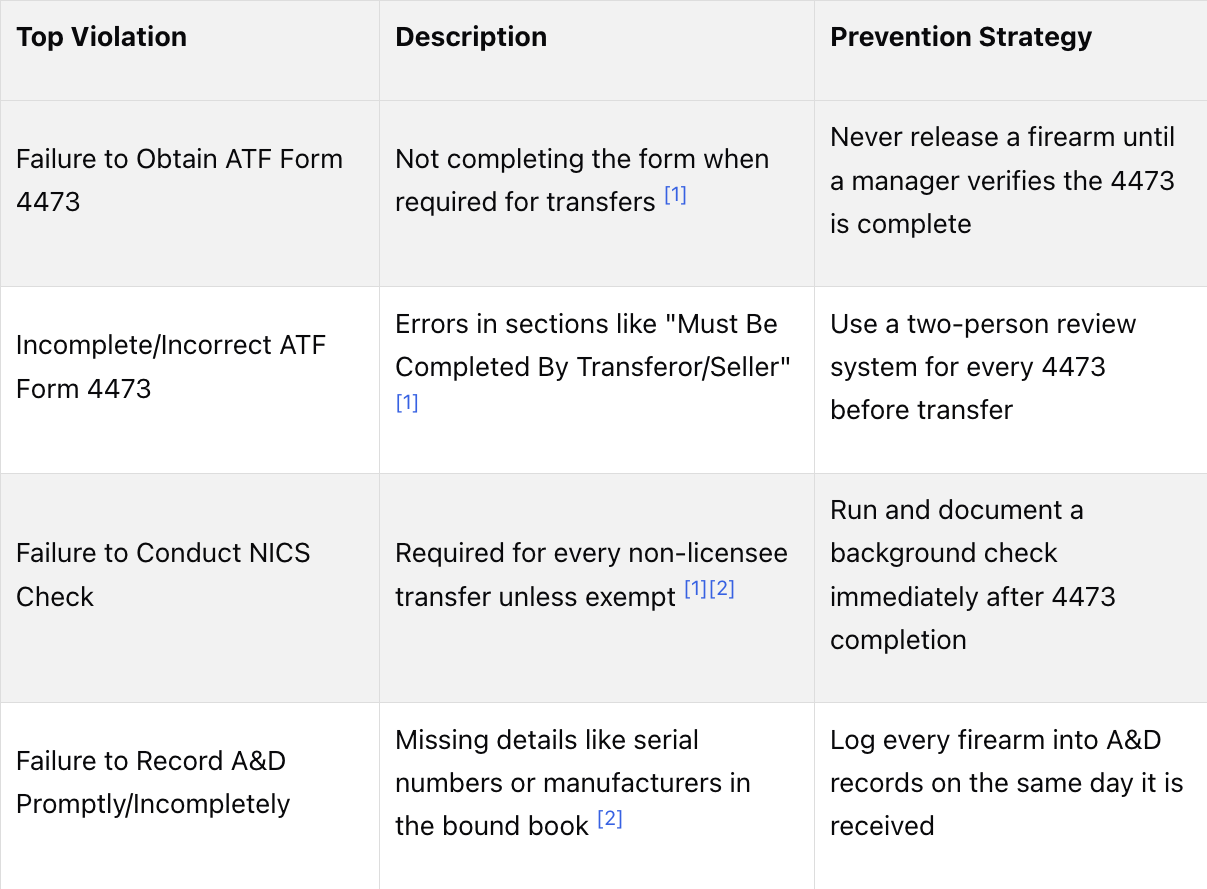
These violations often result from cutting corners in daily procedures - rushing paperwork at closing time, allowing customers to pre-fill forms unsupervised, or relying on memory rather than written checklists. To prevent these issues, pause any transaction if there's uncertainty about the buyer’s ID, responses, or NICS results [1].
Create a "no exceptions" policy where compliance always takes precedence over sales goals. ATF enforcement now emphasizes intent, repeat violations, and whether the issue poses a public safety risk [4][1]. If an internal audit or daily count reveals a missing firearm, treat it as a critical issue. Immediately check your A&D records and recent Form 4473s to determine if the firearm was mis-logged or mis-shelved. If confirmed lost or stolen, follow ATF reporting procedures, notify local law enforcement, and document every investigative step. Quick self-reporting and corrective actions can influence ATF’s response, often resulting in education or warnings instead of severe penalties [4].
ATF Industry Operations Investigators (IOIs) carry out compliance inspections to ensure Federal Firearms Licensees (FFLs) are following federal, state, and local laws. They also review records to spot any illegal activity and provide guidance to help licensees stay compliant. By law, the ATF can conduct one warrantless compliance inspection within a 12-month period during regular business hours [2][3]. However, additional visits may happen if there are unresolved violations or suspicions of criminal activity.
When IOIs arrive, they start by verifying your business structure, ownership details, and the responsible person listed on your license. They’ll also evaluate your physical security measures and conduct an inventory check, comparing the firearms on-site with your Acquisition & Disposition (A&D) records to ensure everything matches. A&D records are closely examined for accuracy and timeliness, and for smaller dealers, inspectors might review all Form 4473 records. For larger operations, they may check a sample to confirm proper completion, legibility, and signatures. They also assess your National Instant Criminal Background Check System (NICS) documentation and procedures, focusing on how you handle denials, delays, and no-response cases.
For FFLs that follow the rules, these inspections are usually educational. IOIs will discuss any violations they find, recommend voluntary corrections, and share tips for staying compliant. But willful violations - like selling to prohibited persons, skipping NICS checks, falsifying records, ignoring trace requests, or refusing inspections - can lead to serious consequences, including license revocation, even for a single offense. Knowing what to expect during inspections underscores the importance of maintaining compliance every day.
Daily compliance habits form the foundation for inspection readiness, but thorough recordkeeping and regular audits are essential to stay prepared. Log all acquisitions as soon as possible and record dispositions by the end of the day. Keep Form 4473 records well-organized - whether by date, alphabetically, or numerically - and separate open forms from completed ones. Attach NICS documentation, including transaction numbers, dates, and responses, directly to the relevant Form 4473 for easy verification during inspections.
Conducting pre-inspection audits can help you catch and fix errors early. Review recent A&D entries to spot missing data or timing issues, and if discrepancies arise, investigate and correct them promptly. Use dated and initialed annotations to make corrections - never erase or use correction fluid. Make sure firearms for gunsmithing, consignment, or personal use are stored separately from dealer inventory, and ensure your FFL license and any state or local permits are current and prominently displayed.
Establish clear operating procedures and invest in regular staff training. Employees should know how to properly complete Form 4473 and follow NICS protocols. Designate one or two primary contacts - such as the owner or compliance manager - who will accompany IOIs during inspections and answer their questions. Train other staff to notify the designated contact immediately when inspectors arrive. You might also find it helpful to hold mock inspections or tabletop exercises to practice retrieving records quickly and accurately.
For additional support, companies like Joseph Chiarello & Co., Inc., with decades of experience in the firearms industry, offer programs designed to identify potential risks in your operations before an official inspection. These programs can assess your compliance and safety measures, while services like employee background checks ensure no prohibited persons are handling firearms or ammunition. Taking these proactive steps not only prepares you for ATF inspections but also strengthens the overall integrity of your business operations.
Managing a firearms business involves more than just day-to-day compliance - it requires solid insurance coverage to handle unexpected risks.
Running a firearms business brings unique risks that standard insurance policies often don’t address. In fact, many mainstream insurance providers either exclude firearms-related operations entirely or impose restrictions that leave Federal Firearms License (FFL) holders exposed. Theft, loss, or compliance issues can lead to financial challenges that generic business policies simply aren’t equipped to handle.
Firearms Business and Property Insurance protects your inventory, building, and equipment against theft, fire, and natural disasters. This coverage is especially critical, as these assets are subject to ATF inspections. If a burglary occurs, this policy helps replace stolen inventory while you work through ATF trace requirements. Commercial General Liability Insurance offers protection against third-party claims, including customer injuries, property damage, or even legal disputes stemming from alleged negligent sales. For your employees, Workers' Compensation Insurance covers injuries that might occur while handling firearms or ammunition, ensuring both their safety and the continuity of your operations.
Specialized providers also offer additional coverage options tailored to the firearms industry. These include crime and theft coverage for high-value inventory, business interruption coverage to safeguard revenue if your business needs to temporarily close after a significant loss, and legal defense coverage for claims related to errors in background checks or documentation. Industry data highlights the stakes: compliance-related incidents can lead to uninsured losses exceeding $50,000 per event. Furthermore, ATF reports consistently emphasize that lost or stolen firearms from FFLs are a major source of crime guns, drawing extra scrutiny to affected businesses.
By securing tailored insurance policies, firearms businesses can better manage risks and focus on their operations with confidence.
For over 40 years, Joseph Chiarello & Co., Inc. has been providing specialized insurance solutions to firearms businesses, including gun shops, shooting ranges, gunsmiths, wholesalers, manufacturers, and importers across the U.S. Their expertise in ATF regulations, NICS procedures, Form 4473 requirements, and security standards ensures that their policies are designed to meet the specific needs of FFL holders, rather than relying on generic small-business templates.
Partnering with an industry specialist offers more than just insurance - it provides access to loss control programs that identify potential risks before an ATF inspection, employee background check services to ensure compliance with firearms handling regulations, and dedicated claims handling by adjusters who understand the unique challenges of the firearms industry. Long-time clients frequently commend the company’s exceptional service and deep understanding of the industry, which helps them navigate operational and regulatory complexities.
If you're a new Federal Firearms License (FFL) holder, focusing on a few essential practices can set the foundation for success. Start by ensuring your Acquisition and Disposition (A&D) records are accurate and up to date. Every firearm entering or leaving your business needs detailed logging, including serial numbers, manufacturers, and models. Conduct NICS background checks for every transfer to a non-licensee unless a specific federal exemption applies. Skipping this step - even once - could lead to license revocation for a willful violation. Lastly, complete every section of ATF Form 4473 to improve firearm traceability and avoid common compliance pitfalls.
These practices are not just about meeting regulations - they're critical for maintaining public safety and staying in business. Alongside recordkeeping, invest in strong security measures to protect your inventory, and establish internal controls, like regular employee checks, to support compliance. The ATF's updated 2025 inspection policy takes a more balanced approach, rewarding FFLs that self-report and correct minor clerical errors, such as missing license numbers. This policy emphasizes collaboration, treating responsible FFLs as partners in reducing firearm trafficking and violent crime.
To keep your operations compliant, take these practical steps. Conduct quarterly audits of your A&D records, inventory, and Forms 4473 to catch and correct errors early. Ensure every NICS check and ID validation is properly documented. Familiarize yourself with the ATF's Quick Reference Guide for best practices and stay updated on regulatory changes.
Once you've mastered these basics, consider additional safeguards like specialized insurance coverage. For instance, partnering with Joseph Chiarello & Co., Inc. can help mitigate risks tied to compliance issues, theft, or documentation errors. They offer tailored solutions such as Firearms Business and Property Insurance, Commercial General Liability, and Workers' Compensation. Their loss control programs can help you identify potential risks before an ATF inspection, while their employee background check services ensure your team meets federal requirements. With over 40 years of experience in the firearms industry, they provide the expertise and support FFLs need to navigate challenges confidently.
New Federal Firearms License (FFL) holders often encounter hurdles when it comes to following ATF regulations. Some of the most frequent missteps include:
Staying on top of these requirements is essential for keeping your business compliant and avoiding penalties. By thoroughly understanding ATF rules and establishing solid procedures from the beginning, you can sidestep these common pitfalls and safeguard your operations.
To get ready for an ATF inspection, new FFL holders should prioritize keeping precise and well-organized records of all firearm transactions, licenses, and inventory. Performing regular self-audits and making sure all employees are trained on ATF compliance rules can help ensure everything runs smoothly.
Staying informed about updates to ATF regulations is equally important. You might also consider designating a compliance officer to manage adherence to federal laws. For extra support, partnering with industry professionals like Joseph Chiarello & Co., Inc. can offer expert guidance and tailored insurance options to help protect your business.
Specialized insurance plays a crucial role for firearms businesses by addressing the distinct risks they face, such as liability concerns, property damage, and employee-related safety issues. Standard insurance policies often fall short in providing the specific protection these businesses need.
Here are the key types of coverage firearms businesses should consider:
Having the right insurance coverage allows firearms businesses to protect their operations, secure their assets, and stay compliant with industry regulations. It’s not just about protection - it’s about running your business with peace of mind.
Don't wait until it's too late to make sure your gun shop is covered. At Joseph Chiarello & Co., Inc., we’re here to help you navigate the ins and outs of gun shop workers compensation insurance to ensure you're prepared for any noise-related risks, including hearing damage. Reach out to us today to review your current policy or get a customized quote. Protect your team and your business with the right coverage—because their safety is worth it.
Call Now: 800-526-2199. Or submit your inquiry below. We look forward to having the opportunity to work with you!