

Commercial General Liability (CGL) insurance helps protect businesses from financial losses due to third-party claims. It covers bodily injuries, property damage, and personal or advertising injuries caused by your business operations. For firearms businesses, CGL insurance is especially important due to the high-risk nature of the industry, addressing lawsuits, legal fees, medical costs, and settlements.
Firearms businesses face unique risks, like firearm-related injuries or negligence claims, making tailored CGL policies essential. These policies often include higher limits and specialized protections for incidents like improper firearm handling or injuries during shooting range sessions. Working with insurance providers experienced in firearms coverage ensures your business is properly safeguarded.
Commercial General Liability (CGL) insurance acts as a financial safety net, offering protection in several critical areas.
Bodily Injury Coverage – This covers claims related to injuries that occur on your property or as a result of your business operations. It typically includes medical expenses, lost wages, and legal fees. For instance, if a customer slips on a wet floor in your store, the policy can cover their medical treatment and any legal costs that arise.
Property Damage Coverage – This helps pay for repairing or replacing third-party property accidentally damaged by your business. For example, if an employee accidentally knocks over and damages a display case while delivering firearms to a client, the policy can cover the repair costs.
Personal and Advertising Injury Protection – This addresses claims for non-physical damages, such as defamation, copyright infringement, or misleading advertising. If your business is accused of spreading false information, this coverage can assist with legal defense costs. These examples highlight the core protections provided, which are detailed further below.
CGL policies are typically divided into three main components:
Additionally, most policies include settlement and judgment payments up to the policy limits. Many also extend coverage to damages involving rented spaces, offering protection if you accidentally damage a leased property.
While CGL insurance offers broad coverage, there are several common exclusions to be aware of:
Understanding these coverages and exclusions is essential for tailoring CGL insurance to the specific risks associated with firearms businesses.
Running a firearms business comes with risks that are far from ordinary. Whether it's a gun shop, shooting range, or firearms distributor, the day-to-day handling of weapons introduces unique challenges. Accidents can occur despite strict safety measures. For example, a customer might accidentally injure themselves while handling a firearm, an employee could damage property during a delivery, or incidents might arise during shooting sessions at a range. As Joseph Chiarello & Co., Inc. Firearms Business Insurance puts it:
When you're handling potentially dangerous weapons all day, it's better to be safe than sorry. [1]
The financial fallout from such incidents can be overwhelming. A single lawsuit for bodily injury could easily cost over $100,000 [2]. Even baseless claims can drain resources quickly when legal fees range between $100 and $500 per hour [5]. Joseph Chiarello & Co., Inc. further emphasizes:
If a customer or employee gets hurt in your gun shop or because of the products you sell, you will be held liable for injuries and damages. This could put you or your business under extreme financial duress. [1]
These risks make it clear: having strong legal and financial protections isn't optional - it's essential.
This is where Commercial General Liability (CGL) insurance steps in as a crucial safety net for firearms businesses. It covers the costs of legal defense, court fees, settlements, and judgments for third-party claims - even if those claims are ultimately unfounded. This protection applies to anyone interacting with your business, including customers, vendors, and suppliers.
CGL insurance is tailored to address the specific liability scenarios firearms businesses face. Whether it's a claim for injury, property damage, or even personal and advertising injuries like defamation or copyright issues in your marketing, this coverage has you covered. As noted by Joseph Chiarello & Co., Inc. Firearms Business Insurance:
Every business needs general liability, but more so gun shops that sell or distribute firearms. [1]
Standard policies typically offer $1,000,000 per occurrence and $2,000,000 in aggregate limits [1], with options for higher limits if necessary. This level of coverage allows firearms businesses to focus on growth without the constant fear of financial devastation.
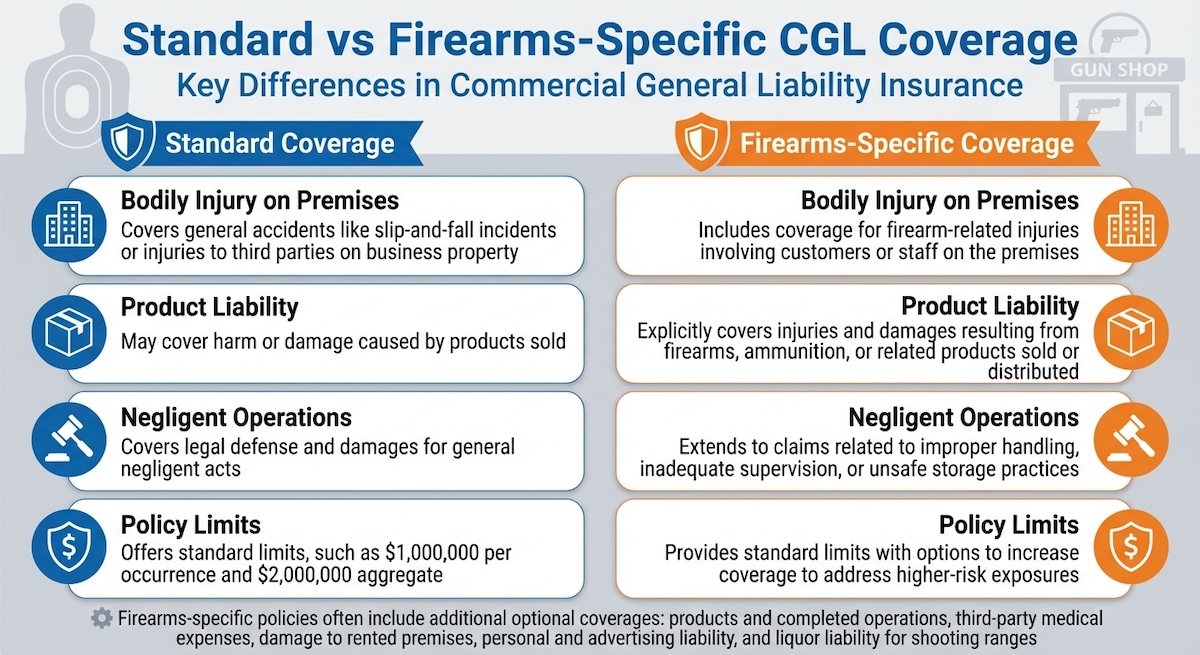
When it comes to firearms businesses, standard Commercial General Liability (CGL) policies often fall short of addressing the unique risks these operations face. While standard policies cover common business risks, firearms businesses require specialized coverage to manage the elevated exposures tied to their industry. Insurers offering tailored CGL policies adapt standard protections, often increasing policy limits to cover the specific needs of gun shops, shooting ranges, and firearms distributors. This specialized approach helps businesses address the unique risks they encounter daily [1].
Premises liability is a key component of tailored CGL policies for firearms businesses. While it includes typical protections like slip-and-fall coverage, it also extends to injuries involving firearms on the property. For instance, if a customer is injured while handling a firearm in your shop or during a shooting session at your range, this provision can help address those claims. It’s designed to respond to the unique risks firearms businesses face on their premises [1].
Negligence claims in the firearms industry can go beyond standard scenarios. Tailored policies specifically cover incidents such as improper firearm handling, lack of supervision at a shooting range, or unsafe storage practices that result in harm to others. For example, if a range instructor fails to supervise a customer properly or a staff member demonstrates a firearm in an unsafe manner, these policies can help cover resulting claims. This coverage ensures that firearms businesses are protected against the specific liabilities tied to their operations [1].
The table below outlines the key differences between standard CGL coverage and policies tailored for firearms businesses:

In addition to these core differences, tailored policies often include optional coverages like products and completed operations, third-party medical expenses, damage to rented premises, personal and advertising liability, and even liquor liability for shooting ranges that serve alcohol. These additional options ensure that firearms businesses have the comprehensive protection they need to manage the unique risks of their industry [1].
Now that we've covered the importance of tailored coverage, let’s dive into how to secure a Commercial General Liability (CGL) policy for your firearms business. This process begins with evaluating your specific risks and ends with choosing a policy that addresses the unique challenges your business faces every day.
Start by identifying the specific risks tied to your operations. A gun shop, for instance, faces different liabilities than a shooting range, a firearms manufacturer, or a training facility. Each type of business has distinct exposures that can shape your coverage needs. For example, shooting ranges must account for risks like equipment malfunctions or test facility accidents, while retail gun shops are more concerned with product liability and customer safety on-site [6][7].
Your location also plays a key role. Factors like local crime rates, natural disaster risks, and state-specific firearm storage laws can influence your liability and the kind of insurance coverage you’ll need [6][8].
Understanding the limits of your CGL policy is crucial. Standard policies typically include six interconnected limits: General Aggregate, Products-Completed Operations Aggregate, Personal and Advertising Injury, Each Occurrence, Damage to Premises Rented to You, and Medical Expense [9].
If your business operates across multiple locations, consider endorsements such as "Designated Location(s) General Aggregate Limits" or "Designated Construction Project(s) General Aggregate Limits." These endorsements allow you to apply aggregate limits separately to different locations or projects, which can help avoid exhausting your overall coverage limit. This approach is particularly useful for businesses managing risks across multiple sites [9][10].
To ensure you’re fully protected, work with a specialist who understands the intricacies of the firearms industry. Firearms businesses operate within a maze of regulations, and specialized providers are equipped to craft policies that address these unique challenges [1][3].
For example, Joseph Chiarello & Co., Inc. has been serving the firearms industry for over 40 years. They offer comprehensive CGL policies that include professional liability, products and completed operations coverage, third-party medical expenses, and even liquor liability for ranges that serve alcohol [1].
"A first class Insurance Broker representing the insured not the insurance company. They are the very best in the business!" - Fritz S. [1][3][4]
Specialized insurers also understand the risks that are unique to gun shops, like product defects or on-premises incidents. They can provide admitted policies that are regulated by state insurance departments, ensuring that your coverage is reliable and leaves no critical gaps [1][3].
Commercial General Liability (CGL) Insurance is a critical layer of protection for firearms businesses, addressing the financial risks tied to operating in a highly regulated and high-risk sector. Whether you manage a gun shop, shooting range, or manufacturing facility, the potential for third-party claims, product liability concerns, and on-site incidents makes solid CGL coverage a necessity for maintaining long-term stability.
The numbers and shifting legal landscape highlight why this protection is so important. In the United States, nearly 48,830 firearm-related deaths occur annually[4]. At the same time, new legislation, like California's AB 1594, is reshaping how liability is assigned in the industry. Even with the Protection of Lawful Commerce in Arms Act, adopted by 34 states since 2005, firearms businesses remain exposed to legal challenges due to various exceptions within the law[4].
To safeguard your business, it’s crucial to assess your specific risk factors - such as your business type, location, and claims history - and ensure your policy limits adequately cover those exposures. For personalized advice, consider working with Joseph Chiarello & Co., Inc., a provider with extensive experience in crafting CGL policies tailored to the unique risks of the firearms industry. Their expertise can help you navigate everything from product liability and on-premises incidents to evolving compliance requirements.
With the right CGL coverage in place, you can focus on growing your business while staying protected from costly legal challenges.
Commercial General Liability (CGL) insurance plays a key role for firearms businesses, offering protection from financial losses tied to lawsuits, medical costs, or property damages. Whether it’s an injury occurring on your premises or an issue linked to your products, this coverage helps shield your business from costly claims involving customers, employees, or third parties.
The firearms industry operates under unique risks and stringent regulations, making CGL insurance an essential safeguard. It helps protect your business from overwhelming legal and financial hurdles, allowing you to concentrate on managing your operations with peace of mind.
Standard Commercial General Liability (CGL) insurance typically covers common third-party risks like bodily injury, property damage, and personal or advertising injury. But for firearms businesses, these standard policies often fall short. Unique risks - like product liability claims stemming from defective firearms or ammunition - are usually excluded and require either additional endorsements or a specialized product liability policy.
Other overlooked areas include theft of high-value inventory, cybersecurity breaches that compromise customer data, business interruptions caused by events like fires or regulatory shutdowns, and employee-related risks such as injuries from heavy lifting or exposure to lead. Without proper coverage, these gaps could lead to significant financial challenges for firearms businesses.
Joseph Chiarello & Co., Inc. steps in to bridge these gaps with tailored CGL solutions. Their policies include key protections like product liability, theft coverage, cyber liability, business interruption insurance, and umbrella policies - offering firearms businesses the comprehensive protection they need.
Firearms businesses have the flexibility to tailor their Commercial General Liability (CGL) insurance to fit the specific risks they face. For instance, they can include products and completed operations coverage to address liability concerns related to defective firearms or ammunition. Similarly, adding third-party medical expense coverage can help cover costs if someone is injured on their premises. Other options like damage to rented premises and personal and advertising liability can be added to address additional vulnerabilities.
To further refine their policies, businesses can opt for endorsements. For example, they might add liquor liability coverage if they host events where alcohol is served or increase coverage limits to protect high-value inventory. Beyond the core policy, services like background checks and loss-control consulting can provide extra layers of protection. By customizing coverage and leveraging these options, firearms businesses can create insurance plans that align closely with their operations and risk levels.
Don't wait until it's too late to make sure your gun shop is covered. At Joseph Chiarello & Co., Inc., we’re here to help you navigate the ins and outs of gun shop workers compensation insurance to ensure you're prepared for any noise-related risks, including hearing damage. Reach out to us today to review your current policy or get a customized quote. Protect your team and your business with the right coverage—because their safety is worth it.
Call Now: 800-526-2199. Or submit your inquiry below. We look forward to having the opportunity to work with you!