
Most denied claims in firearms businesses trace back to the same 7 policy gaps. I’m talking about inventory values set too low, no transit coverage, building limits based on sale price instead of rebuild cost, missing post-work liability, missing product liability, wrong workers’ comp class codes, and no cyber coverage for digital records.
If I run a firearms insurance audit, I’m checking one thing first: does the policy match how the business works today? That matters because a shop can add gunsmithing, training, range work, or gun shows and still carry a policy built for a simple retail counter. And that mismatch can turn a fire, theft, injury claim, or data breach into a denied or short-paid loss.
Here’s the full short list:
A few numbers show why this matters:
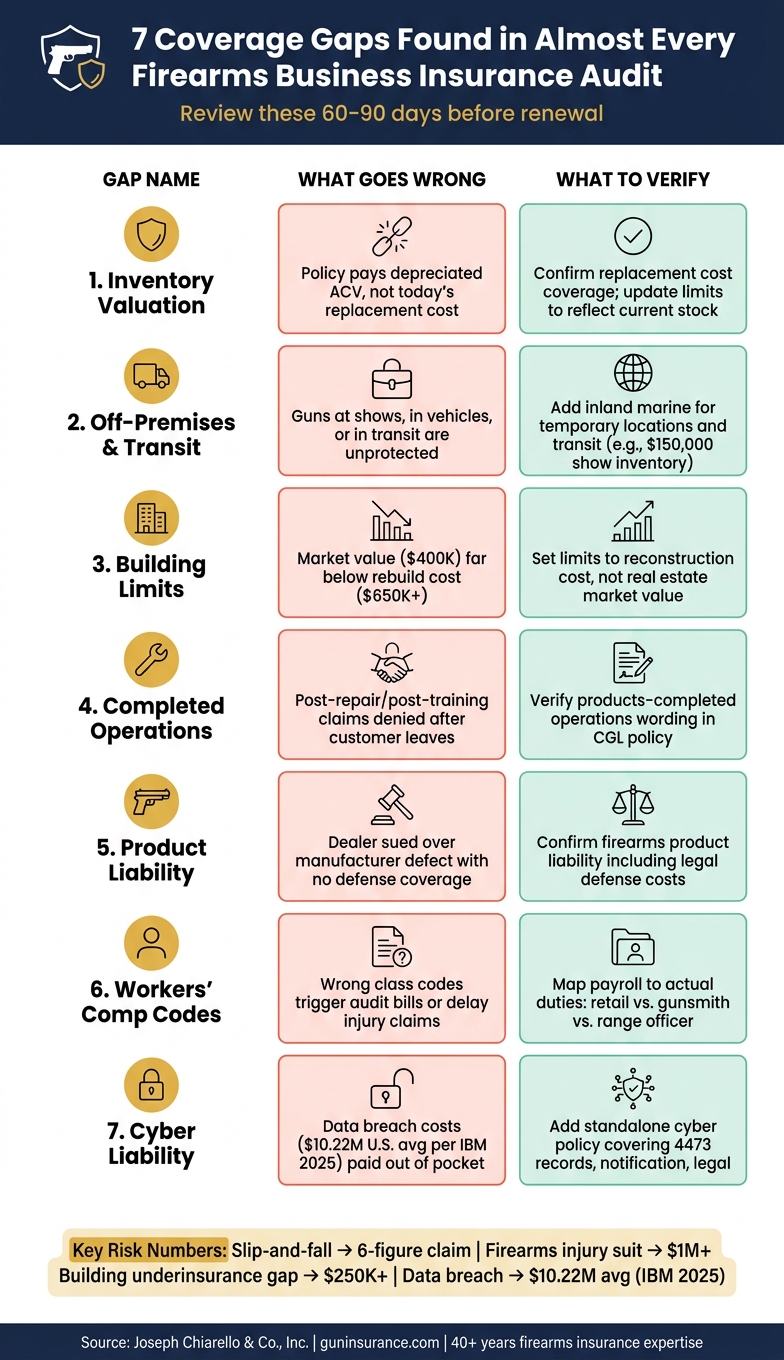
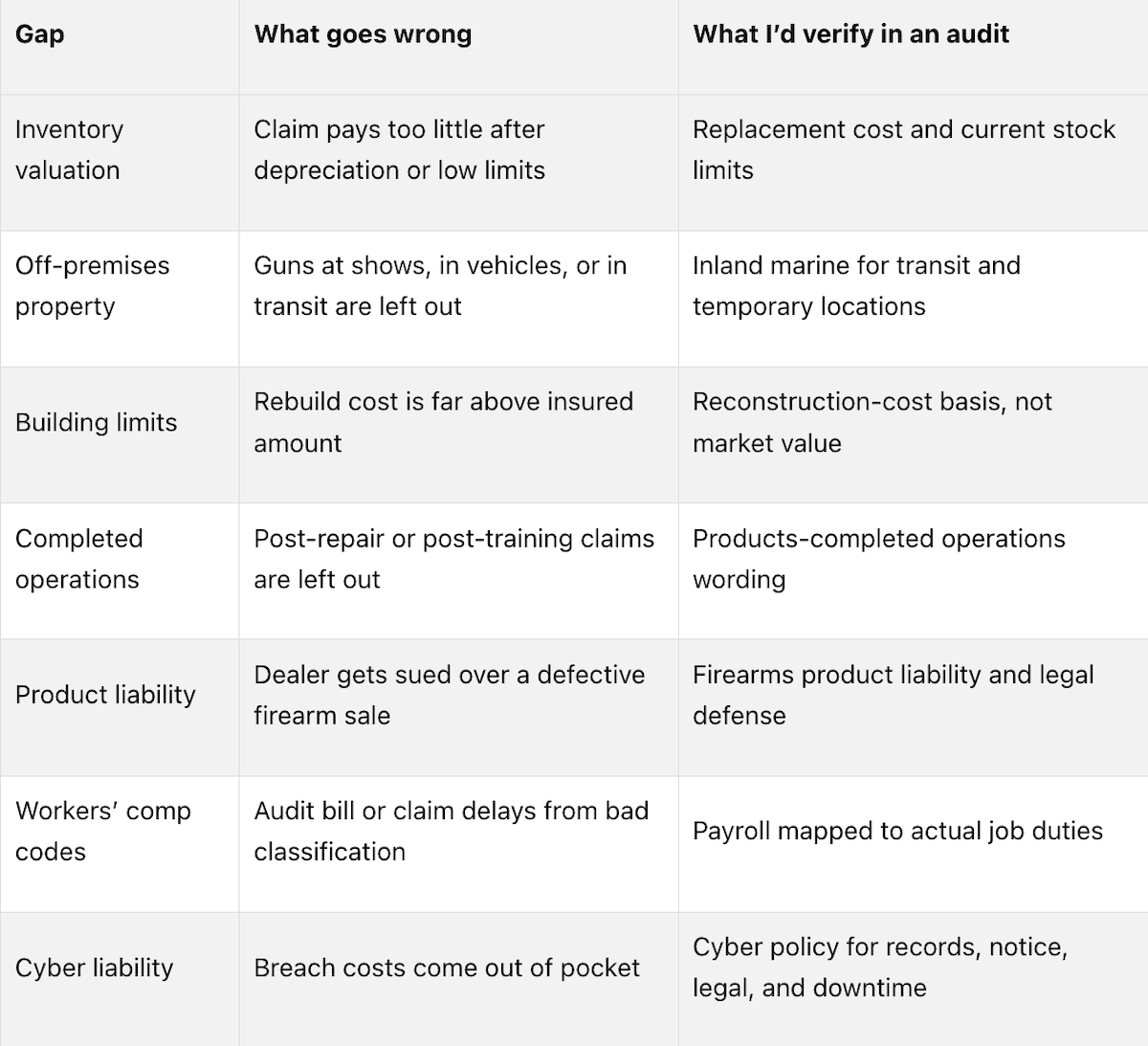
Bottom line: I’d review these 7 areas 60 to 90 days before renewal so there’s time to fix limits, endorsements, and class codes before a claim exposes the gap.
These three gaps all deal with physical assets: inventory, buildings, and firearms on the move. They tend to show up during a firearms business insurance audit when policy limits and coverage terms no longer line up with how the business runs today.
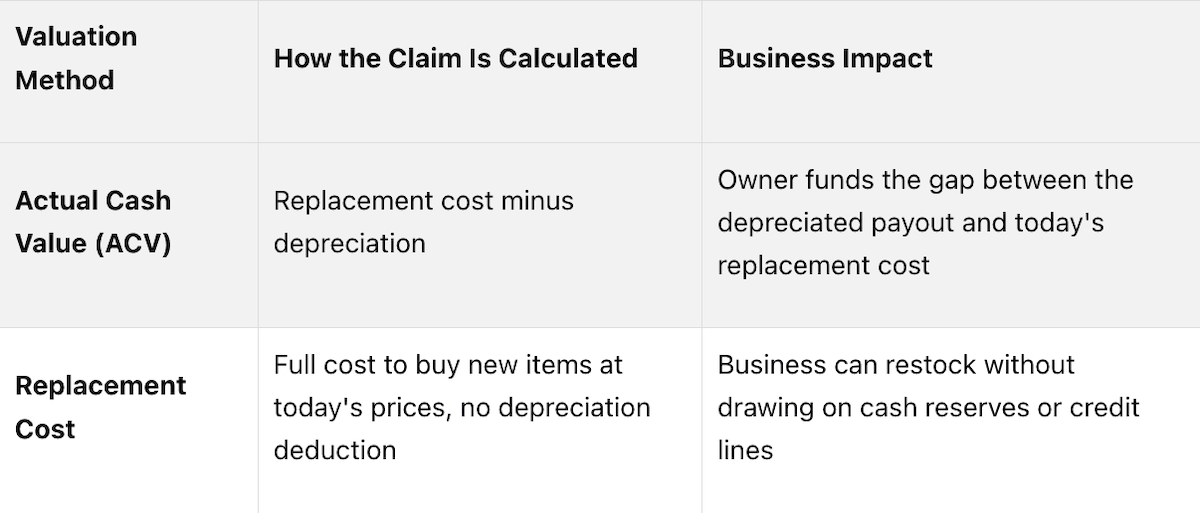
A lot of commercial property policies default to actual cash value (ACV). That means the claim is paid based on depreciated value, not what it would cost to restock today.
That sounds fine on paper. In practice, it can hurt.
Firearms prices shift with demand, supply chain issues, and manufacturer price changes. So a handgun bought at wholesale three years ago may cost much more to replace now. Under ACV, the adjuster subtracts depreciation from each item. The payout can end up far below the amount needed to put that product back on the shelf.
The problem gets worse when a shop has grown its inventory but never updated its limits. After a fire or major theft, the owner gets hit from both sides: depreciation cuts the payout, and the policy limit may be too low for the amount of stock actually on hand. That’s how a claim can end up denied or only partly paid at the worst time.
Even if inventory is valued the right way, there’s another issue: where the guns go once they leave the premises.
Standard property policies are built around one fixed address. The moment firearms leave the store, coverage may stop. That includes inventory taken to a gun show, moved to an offsite range, or picked up for gunsmith work.
This is where inland marine coverage comes in. It covers movable property, including goods in transit, items at temporary sites, and property away from the main insured address. Without it, a dealer with $150,000 in inventory stolen from a vehicle overnight at a gun show may learn the loss is not covered away from the insured location. [5]
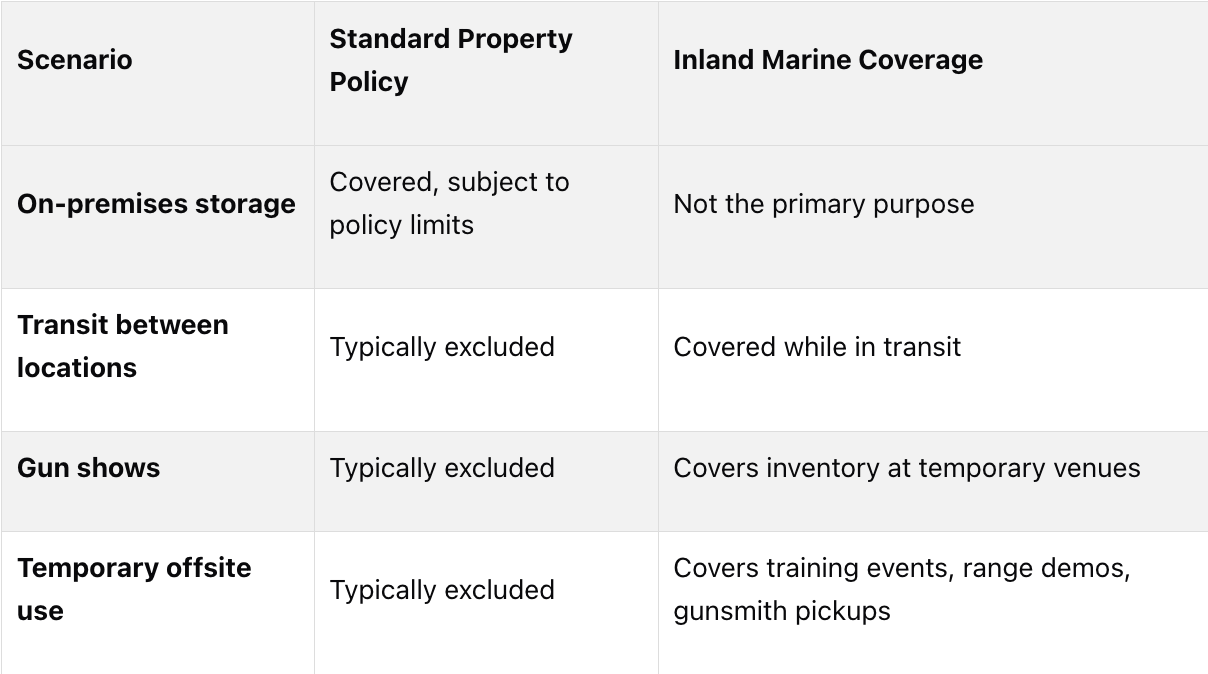
That offsite assumption trips up a lot of owners.
The same kind of valuation problem shows up with the building itself.
Market value is what someone might pay for the property in the current real estate market. Reconstruction cost is what it would take to rebuild the structure from the ground up using current labor and material prices. For a firearms business, that also includes special features like reinforced vaults, ballistic glass, range ventilation, bullet traps, soundproofing, and security systems.
Those numbers can be far apart. A building with a $400,000 market value can cost $650,000 or more to rebuild to current code requirements. [1]
When the policy limit is based on market value, the business is often underinsured. On top of that, many commercial property policies include a coinsurance clause. If the building is underinsured, that clause can shrink the payout on a large claim.
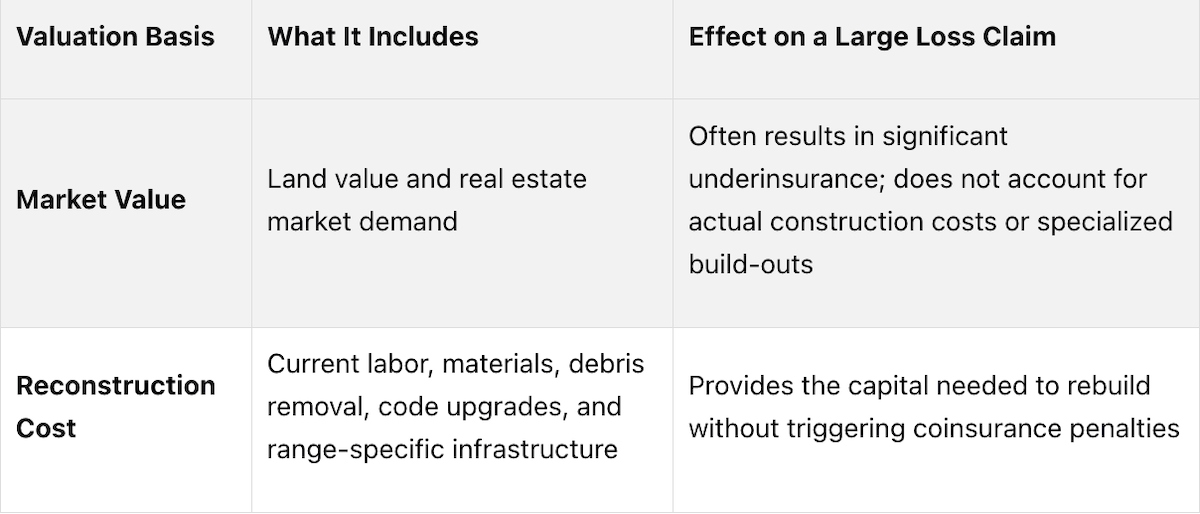
A specialist audit checks whether the building limit matches rebuild cost, not market value.
Once property values are set, the next place things tend to break is liability wording.
These gaps are often more painful than property mistakes. If a claim gets denied, the business may have to pay for its own legal defense, and firearms-related injury litigation can run past $1,000,000 per case. [2] In most cases, the problem starts with a simple but costly belief: the policy covers more than it actually does.
The first issue usually shows up after the job is finished and the customer is long gone.
Most owners know their CGL policy is meant to cover injuries that happen on-site. If an accidental discharge happens on the range during a supervised session, that is a standard on-premises claim that CGL will usually cover.
Completed operations is different. It applies to injury or damage that happens after the work is done and the customer has left. Say a gunsmith performs a trigger job and returns the firearm to the customer. If that trigger fails two weeks later and causes an injury at the customer's home, that is not a premises claim. It falls under completed operations. That is why a policy can seem fine at first glance, then fail at the exact moment a post-work claim comes in.
The problem starts when the policy excludes products-completed operations - post-work liability - or puts a lower sub-limit on it than the main liability limit. The wording is technical, and it often sits in an endorsement that the owner never spots. [4] [7]
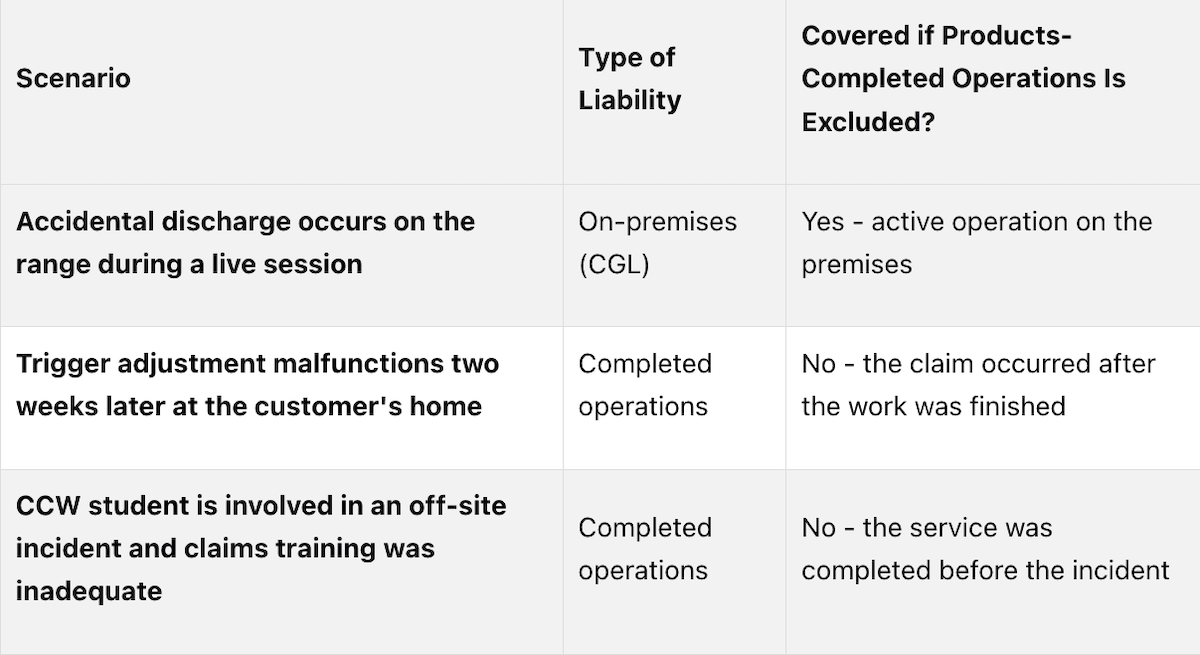
The next gap shows up when a product leaves the store and later injures someone somewhere else.
A dealer can still get pulled into a lawsuit over a malfunctioning firearm even when the defect began with the manufacturer. This gap usually opens when the dealer assumes the manufacturer's policy will handle the loss, or assumes the dealer's own CGL policy covers it by default. In many cases, neither is true.
Manufacturer policies usually do not list dealers as additional insureds, and many dealer CGL policies are endorsed to exclude or sharply limit the products hazard for firearms. [4] [7] So if a customer says a handgun sold by the store discharged without trigger input and sues both the manufacturer and the retailer, the dealer needs its own product liability coverage to pay for a defense. Without that coverage, legal fees and any settlement can land straight on the business. [3] [6]
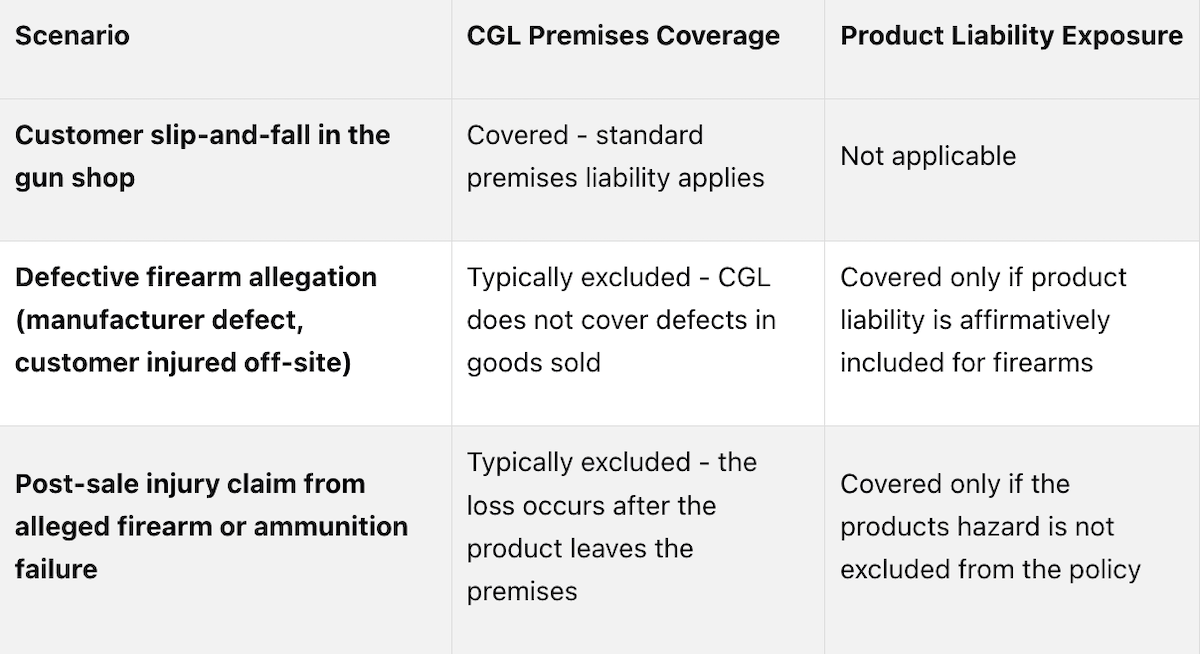
Check the declarations page for any products-completed operations exclusion. If that wording is there, post-sale and post-repair claims involving firearms are likely not covered. [7]
The next audit failures are less visible: class codes and digital records.
The last two gaps are day-to-day issues: the policy no longer lines up with how the business works now.
Workers' comp problems show up when payroll no longer matches the policy. Class codes are based on job duties, not job titles. Someone working a sales counter faces a different injury risk than someone doing barrel work in a gunsmithing bay or overseeing live fire on a range.
Trouble starts when a retail shop adds gunsmithing or range work but never updates the class code. The original retail classification stays on the policy, so the insurance still reflects an older version of the business.
That mismatch often comes out during the insurer's audit. The auditor compares the codes listed on the policy with what employees actually do. If a gunsmith's payroll was reported under a retail sales code, the auditor moves that payroll to a higher-rated gunsmithing classification and issues a retroactive premium correction.[13][14][15] If an injury happens, that mismatch can also slow the claim when the employee's actual duties do not match the classification schedule.
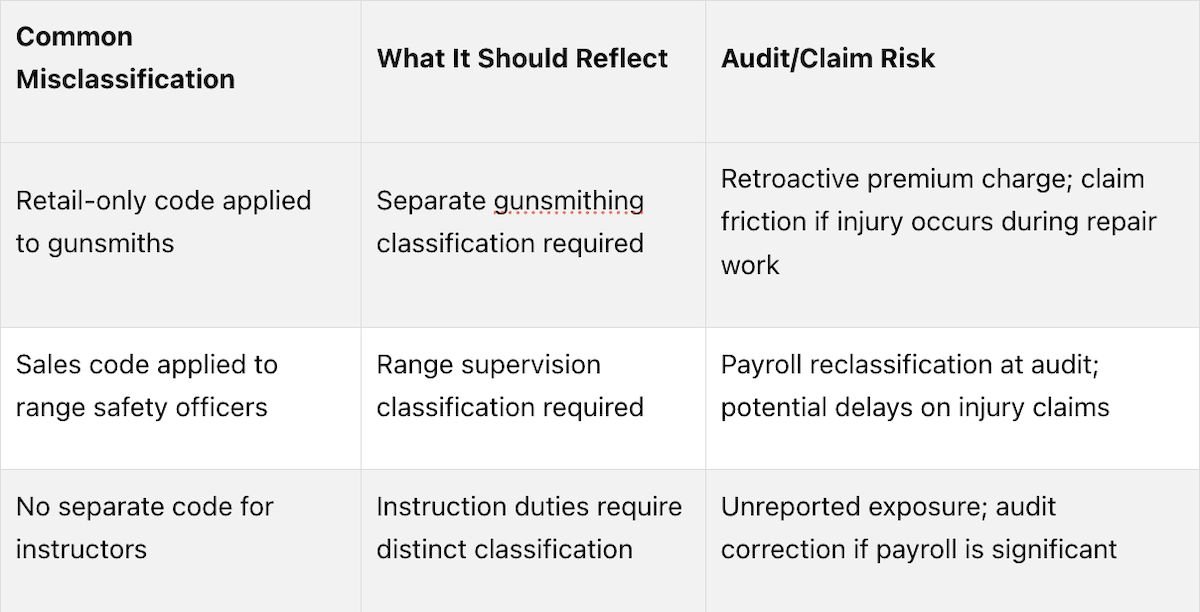
A simple fix goes a long way: 60 to 90 days before renewal, review every function the business now performs and check that the codes on the declarations page still fit. If the shop added a new service after the policy was first written, there's a good chance the codes need to change.
The same kind of lag shows up with digital records too.
A lot of shops now keep Form 4473s, ID scans, and payment data in digital systems. If that system gets breached, standard property and general liability policies usually won't help. General liability and property forms usually exclude data breaches and electronic records.[11][12] That usually includes 4473s and customer data.
The out-of-pocket hit from a breach can be brutal. IBM's 2025 Cost of a Data Breach Report puts the U.S. average breach cost at $10.22 million, with smaller organizations averaging $3.31 million in prior-year segmentation data.[9][10] A well-built cyber policy can pay for:
ATF requires these records to be kept for 20 years after sale or disposition,[8] so a breach today may expose a large archive of customer data. A firearms-specialist audit should verify how those records are stored and whether cyber coverage is in place. It should check both before renewal.
After you spot these gaps, the next move is simple: run a focused audit before renewal.
A lot of firearms businesses don’t find these problems until a claim gets denied. By then, the damage is done. The good news? The fix isn’t complicated. You need a firearms-specific audit from someone who understands the coverage triggers that matter in this industry.
A standard commercial review often misses these issues because it wasn’t built for firearms operations. It may look fine on paper, but that doesn’t mean it lines up with how a gun store, range, gunsmith, or instructor actually operates day to day. A firearms-specific audit makes more sense because it compares the policy language to the way the business runs in practice.
A thorough audit should review each of these points before renewal:
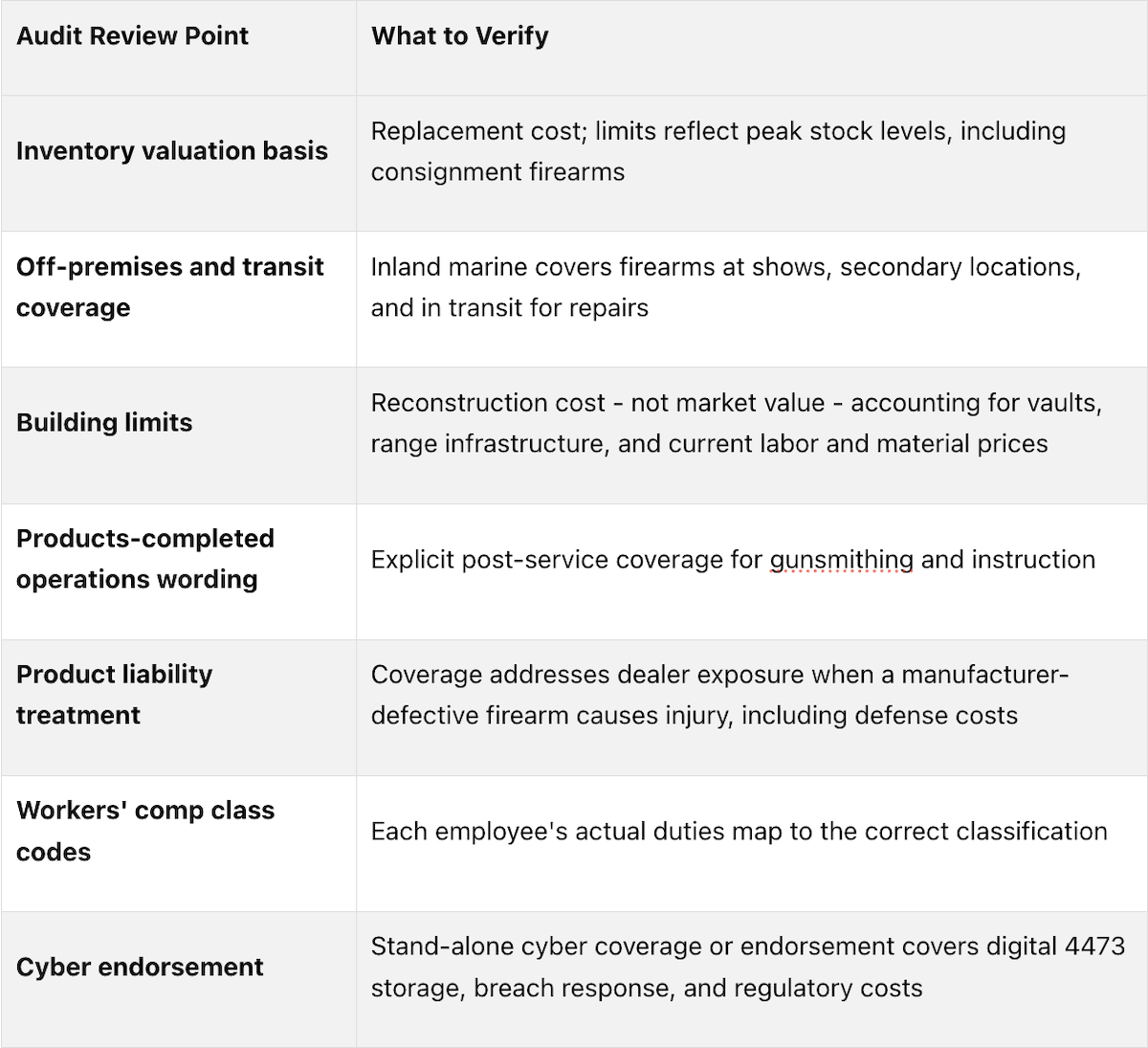
Start this review 60 to 90 days before renewal. That gives you time to fix limits, endorsements, and class codes instead of scrambling at the last minute.
Joseph Chiarello & Co., Inc. (guninsurance.com) has 40+ years of firearms-industry experience and uses a firearms-specific underwriting process to identify and close these gaps before renewal.
You’re likely underinsured if your limits don’t line up with your actual inventory, day-to-day operations, and what it would cost to replace what you own.
Check that your building is insured for replacement cost, not market value. Make sure your inventory numbers are up to date, and that your policy matches how your business runs, including workers’ comp class codes and any inland transit coverage you may need. The fastest way to verify all of this is to get a specialist coverage audit before a claim gets denied.
No. Standard general liability or a basic business policy usually does not cover the risks that come with transporting firearms to shows or between locations.
Joseph Chiarello & Co., Inc. points out that you usually need specialized firearms transport liability insurance and/or inland marine coverage to protect inventory while it’s in transit. If you don’t have that extra coverage, a claim tied to a transit incident can be denied.
Get a firearms business insurance audit at least once a year. The best time is 60 to 90 days before your renewal date. That window gives you time to update records, check asset values, and work with a specialist to fix coverage gaps before the new policy starts.
You should also review your coverage right after major changes to the business. That includes renovations, expansion, security upgrades, legal restructuring, or adding high-value inventory.
Don't wait until it's too late to make sure your gun shop is covered. At Joseph Chiarello & Co., Inc., we’re here to help you navigate the ins and outs of gun shop workers compensation insurance to ensure you're prepared for any noise-related risks, including hearing damage. Reach out to us today to review your current policy or get a customized quote. Protect your team and your business with the right coverage—because their safety is worth it.
Call Now: 800-526-2199. Or submit your inquiry below. We look forward to having the opportunity to work with you!