

Vendor contracts are a critical part of ensuring smooth operations for firearms businesses. They outline responsibilities, mitigate risks, and play a key role in maintaining compliance with strict industry regulations. Poorly drafted contracts can lead to supply disruptions, legal liabilities, and financial losses. Here's what you need to know:
Firearms businesses face unique challenges, from regulatory compliance to supply chain risks. Strong vendor contracts and tailored insurance solutions are essential for continuity and reducing disruptions.
These contract-related issues can jeopardize your business operations by introducing legal and operational risks.
When contract terms are vague or incomplete, the drafting party often gains the upper hand, leading to unpredictable outcomes [1]. For instance, if your vendor contract lacks specifics about deliverables, quality standards, or responsibilities, disputes can arise that disrupt operations. Missing termination clauses can trap you in a partnership with a non-performing vendor, and trying to exit could be seen as a breach of contract [1][4].
The financial risks are equally concerning. Many vendor contracts include standardized language that limits the vendor's liability to the cost of your order. This might not even come close to covering the losses your business could face during a disruption [2]. This issue is particularly critical in industries like firearms. As Camden R. Webb and Charles E. "Chuck" James, Jr. from Williams Mullen point out:
"If you purchase a component part that infringes another company's patent and you haven't established the vendor's responsibility for indemnification in a contract document, you are left with less-than-certain rights to recover from the vendor" [6].
Without clear indemnification clauses, businesses can end up bearing legal costs that should fall on the vendor.
When vendors fail to meet the compliance standards outlined in your contracts, the consequences can be severe. Legal penalties, investigations, and reputational harm are just a few of the risks [1][3]. For example, an audit by the Office of the Inspector General revealed that nearly 50% of reviewed claims related to specific device credits were improperly reported [3]. Such failures can lead to fines and investigations, potentially halting your operations.
Overdependence on a single supplier is a major vulnerability. If that vendor faces bankruptcy, a natural disaster, or even a cyberattack, your operations could grind to a halt [11][12]. In 2023, 54% of surveyed companies reported breaches caused by third parties, and over 30% of all data breaches were linked to third-party failures [13].
The risks don’t stop with your direct vendor. Michael Herrera, CEO of MHA Consulting, highlights the broader implications:
"A chain is only as strong as its weakest link. If your organization relies on unprepared third-party vendors for critical materials and services... your organization might also be disrupted" [12].
Relying on one vendor also weakens your negotiating position and can lead to complacency in quality and service [11]. Without alternative suppliers, even a brief disruption can result in missed deliveries and lost revenue. Tackling these challenges ensures your vendor contracts are more resilient and better equipped to handle unexpected issues.

Restructuring vendor contracts is a straightforward way to bolster operational continuity for your firearms business. By incorporating specific, enforceable terms, you can address risks like regulatory noncompliance and vague agreements. A well-structured contract transforms unclear promises into clear obligations, making your operations more resilient.
One of the most effective ways to protect your business is by eliminating ambiguity in vendor agreements. Clearly outline deliverables, including quality standards and acceptance criteria. For instance, if you’re sourcing component parts, specify the exact Acceptable Quality Level (AQL) - this defines the number of defects you’ll tolerate before rejecting an entire shipment, which then becomes the vendor’s responsibility to address [2].
Your contracts should also include detailed notification protocols. Require vendors to inform you of any disruptions within 1–2 hours and set up both primary and secondary communication channels for reliability [7]. This quick response time allows you to implement contingency plans before minor issues escalate.
For long-term partnerships, consider using a Master Sales Agreement instead of relying solely on purchase orders. This approach sets clear ground rules for operations and establishes a solid foundation for ongoing collaboration [6]. Once roles are defined, the next step is to integrate compliance measures to safeguard your business.
Generic phrases like "applicable law" don’t cut it when it comes to compliance. Your contracts should explicitly reference specific regulations, such as those outlined in 27 CFR Part 478, so vendors understand their responsibilities in maintaining your federal firearms license [14][15]. This level of detail is especially important for adhering to ATF record-keeping rules or meeting state-level licensing requirements.
Include cascading clauses that hold your primary vendors accountable for ensuring their sub-vendors meet the same compliance and security standards [14][16]. To verify these standards, give yourself audit rights, allowing for facility inspections or record reviews [14]. Additionally, require vendors to carry General Liability and Product Liability insurance, and make sure they provide a Certificate of Insurance as proof [2][16].
Define "Termination for Cause" in your contracts to cover specific regulatory failures, such as losing an FFL, repeated safety violations, or data breaches. For vendors handling sensitive information, include a clause requiring them to notify you of any security breaches within 24–72 hours [16]. Once compliance is addressed, focus on building flexibility into your agreements to handle unforeseen disruptions.
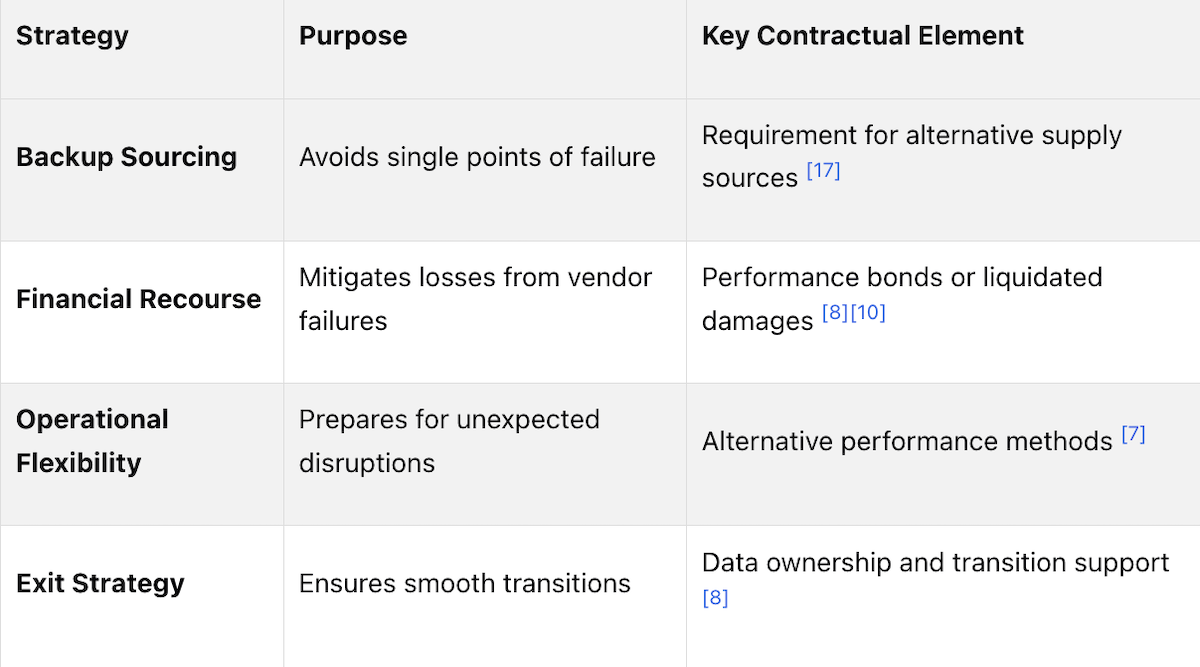
Operational flexibility is key to maintaining continuity. Anticipate potential disruptions by requiring vendors to have backup plans. This could include alternative sources of supply, replacement personnel, or spare equipment [17]. For technology-driven goods or equipment, a technology escrow clause can guarantee access to essential blueprints or source code if the vendor goes bankrupt [2].
Force majeure clauses should clearly define how vendors will resume services or allow you to switch to an alternative provider during disruptions [2][10]. As Lorman Education Services emphasizes:
Consider adding performance bonds, which provide financial compensation or fund remedial work if a vendor fails to meet their obligations [8]. Liquidated damages clauses can also ensure you’re compensated for vendor failures beyond the cost of the order [10]. Lastly, include exit clauses that require vendor cooperation during transitions - this might involve data transfer, asset returns, or adhering to defined notice periods [17][8].
Even the most carefully crafted vendor contracts can’t eliminate every risk. That’s where insurance steps in, offering a financial safety net to keep your firearms business running smoothly when suppliers falter. By minimizing disruptions and covering unexpected losses, the right insurance can make vendor-related challenges far more manageable. Let’s break down how specific types of insurance can safeguard your business from vendor-related risks.
When disasters like fires or floods disrupt a key supplier, contingent business interruption insurance can help. This type of coverage compensates for lost income and ongoing expenses while you search for alternative suppliers or wait for your vendor to recover[18]. By working with your insurance agent to add this coverage, you expand your protection beyond your own operations. Additionally, ensure vendors provide proof of their own insurance, including general liability, product liability, and - if applicable - errors and omissions coverage[19].
Mistakes by vendors can expose your business to legal risks, even when you’re not directly at fault. Commercial General Liability insurance shields your business from third-party claims involving bodily injury, property damage, or advertising injury tied to vendor actions[20]. For example, if a defective firing pin leads to an injury, your business could face vicarious liability[20][21]. According to Ayala Law PA, indemnity provisions in contracts mean that vendors are responsible for covering defense costs in such cases[20]. However, this only works if the vendor has the financial capacity to fulfill that promise. To strengthen your position, request "Additional Insured" status on vendor policies and include a "duty to defend" clause in your contracts. This ensures vendors are obligated to cover legal defense costs upfront[20][21].
Firearms businesses face risks that standard insurance policies may not fully address. These include high-value inventory theft, specialized product liability concerns, and strict regulatory compliance. Providers like Joseph Chiarello & Co., Inc. offer tailored solutions to fill these gaps, such as Workers' Compensation, Business and Property Insurance, and Commercial General Liability Insurance. These policies are designed to align with federal and state requirements, ensuring your business complies with ATF reporting and background check protocols. They also account for the unique challenges firearms businesses face, like liability from defective components, which can lead to severe legal and financial consequences[18].
Strong vendor contracts are essential for ensuring smooth operations in firearms businesses. Including clear performance metrics - such as Recovery Time Objectives (RTOs) and Recovery Point Objectives (RPOs) - sets measurable standards for how quickly vendors must recover from disruptions[7]. To reinforce these expectations, use "Time is of the Essence" clauses and liquidated damages provisions, which emphasize timely delivery and establish pre-determined compensation for failures[1][10]. As Gary Smith, Founding Member of Guidant Law Firm, explains:
"One size doesn't fit all. To minimize lawsuits and liability, companies must tighten their contracts by tailoring them to their individual business conditions."[10]
Instead of relying on generic boilerplate language, customize contracts to reflect the specifics of your business relationships. Include both "for cause" and "for convenience" termination clauses to avoid being stuck in unproductive agreements[1][9]. If a vendor shows signs of financial instability, leverage UCC § 2-609 to request written assurances, such as a letter of credit, to mitigate risks before they escalate[9]. Additionally, maintaining backup relationships with alternative suppliers and requiring vendors to notify you of disruptions within 1 to 2 hours can help you activate contingency plans without delay[7][18].
Insurance can also address gaps that contracts alone cannot cover. For example, contingent business interruption coverage can offset income losses caused by supplier disruptions, while Commercial General Liability insurance protects against legal claims stemming from vendor errors. Providers like Joseph Chiarello & Co., Inc. offer insurance solutions tailored to the unique challenges faced by firearms businesses.
These strategies provide a clear path to improving operational resilience.
Take a close look at your current vendor contracts. Check for vague language, missing performance benchmarks, and inadequate termination options. Define RTOs, incorporate "Time is of the Essence" clauses, and add liquidated damages provisions to ensure faster recovery times[7][10]. Before finalizing any agreement, confirm that vendors have the proper licenses, financial stability, and sufficient insurance coverage[4].
For additional support, visit guninsurance.com to connect with Joseph Chiarello & Co., Inc. Their team specializes in Workers' Compensation Insurance, Firearms Business and Property Insurance, and Commercial General Liability Insurance. They can help you navigate the regulatory landscape and develop a risk management plan to keep your operations running smoothly, even in the face of vendor disruptions.
Key clauses for maintaining vendor continuity include: identifying and assessing risks, setting clear notification and escalation procedures, establishing measurable recovery time objectives (RTOs), and including flexibility for unexpected events. These components help ensure your business can stay strong and adaptable during disruptions.
To ensure a vendor complies with federal firearms laws, start by consulting official ATF resources. Key actions include verifying the vendor's licensing status and confirming they follow federal regulations. It's also important to review their compliance inspection history and check whether they maintain proper records. Additionally, conduct background checks and confirm they adhere to the Gun Control Act and National Firearms Act. These steps are essential for ensuring the vendor operates within federal firearms laws.
Insurance policies like umbrella coverage or cyber liability insurance go beyond what contracts can handle, offering an extra layer of protection. These types of insurance safeguard your firearms business from risks such as liability claims, property damage, cyberattacks, and even business interruptions. They help ensure your business is better protected against unforeseen challenges.
Don't wait until it's too late to make sure your gun shop is covered. At Joseph Chiarello & Co., Inc., we’re here to help you navigate the ins and outs of gun shop workers compensation insurance to ensure you're prepared for any noise-related risks, including hearing damage. Reach out to us today to review your current policy or get a customized quote. Protect your team and your business with the right coverage—because their safety is worth it.
Call Now: 800-526-2199. Or submit your inquiry below. We look forward to having the opportunity to work with you!